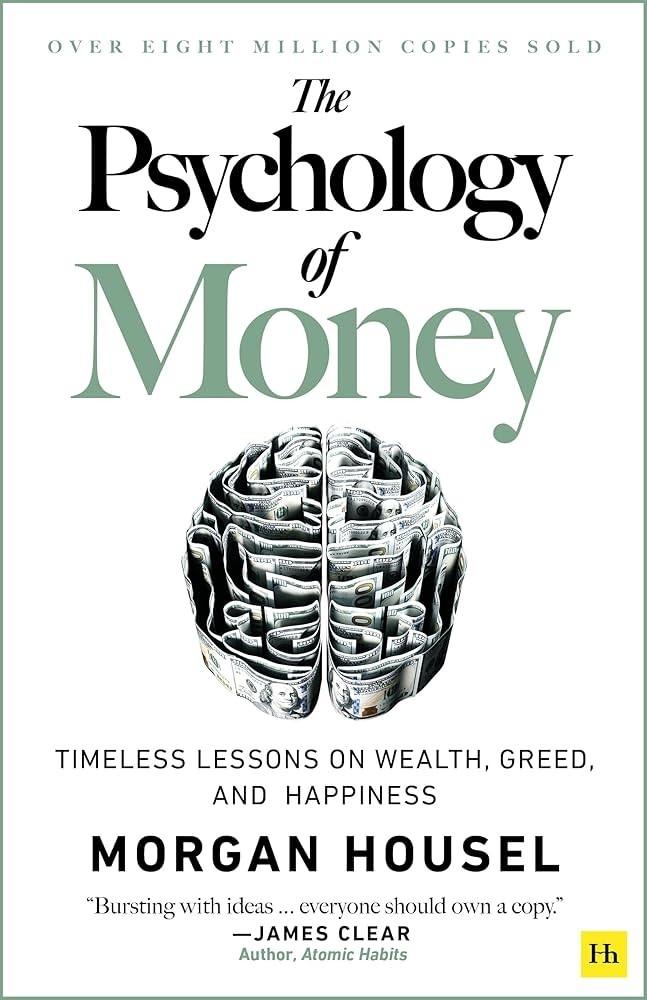
Part 2: The Psychology of Money by Morgan Housel
Book Summary Part 2
Have a Margin of Safety
Having a margin of safety makes it more likely you will succeed. It's important to plan for things not going acording to plan. If your retirement goals allows you to be OK should your investments return 4% annual growth for the next 30 years, than you have more room for error if the actual return on investments is 8%.
Butgeting, flexibility and long time horizons allows you to succeed with a range of outcomes. It makes sense to be optimistic about the future, but it's also useful to be paranoid about what may keep you from getting there.
You Can be Wrong and Still Win.
Unlike otherfields, investing doesn't require that you be perfect all the time. Art dealer Heinz Berggruen was an art collector who bought a lot of art and held them for a long period of time. Only 1% of his collection turned out to be valuable, such as the works of Picasso, while the remaining 99% held little value. In the end, the valuable subset of artwork was worth a billion dollars! The large amount of art aquired acted like an index fund. The farthest ends of a distribution of outcomes have the most influence in finance, causing a small number of events to account for most of the outcomes.
An investor can be wrong half the time and still succeed. We underestimate how normal it is for things to fail, which causes us to overreact.
Venture capital is another example of this, an investment firm study looking at 21000 venture financing between 2004-2014 found more than half of financial ventures failed, 2.5% made 10-20X return, 1% percent generated more than 20X return and 0.5% percent 50X or more.
What is intersting is that the distribution amoung large public companies is very similar. Most publically traded companies fail, a few do well and only a handful will go on to become extremly sucessful bussiness that will account for most of the gains on the stock market.
How you behaved as an investor duirng 2008 financial crash would have had more of an impact on lifetime returns than everything between 2000-2008. During the difficult times, the successful investor is the person who can do the average thing while everyone else around them goes crazy.
Time Freedom leads to Happiness
The highest form of wealth is to wake up in the morning and do what you want for how long you want. Having the most control over your time was shown to be the greatest contributer to happiness. Compaired to previous generations we have less control over our time, short of those who work with their hands, the workday is longer, and office workers continue to think about their jobs, recieving emails while at home.
We are also less happy when we opt for the larger homes and more stuff that cause us to lose control of our time. Hence, even if we are richer than a generation ago, we feel less happy. No one on their death bed regrets not working more, instead people valued friendships, spending time with loved ones. Your kids don't want more money anywhere near as much as they want time with you.
Having flexibility and control over our time provides an unseen return on wealth. Giving you the option to change careers, leave bad situations, invest in further skills, take on work that aligns with your passions or retire earily.
Status Symbols don't Work
No one is impressed with your possessions as much as you are. People may want a huge house, an expensive car or a fancy watch to signal wealth because they think it will make people respect them, but it doesn't work. People don't notice the driver, they only see the luxury car.
People want to be respected and admired by others, but using your money to buy these status symbols doesn't work. Humiliy, kidness and empathy will earn you far more respect.
Wealth is what you don't see.
Spending money to show off how rich you are is the fastest way to lose money. When the author worked as a valet, he realized that most people who buy luxury cars were mediocre individuals who spent a large amount of their paycheck on a car. We tend to judge wealth by what we see, but we can't see their brokerage statements. Instead we judge based on their cars, homes, and instagram accounts. Real wealth is built by the financial assets that haven't yet been spent. Wealthbulding is hidden, it's the income not yet spent (and hence converted to stuff you can display. ) Deep down what people want is time freedome and flexibility.
People learn by example/ imitation unfortunately, it's hard to learn from what you can't see. That's why its so hard to build wealth. Don't judge others or yourself, the world is filled with people who appear rich but are in debt and people who appear modest but are wealthy.
Save Money: The only factor that matters and the only one you can control
Wealthbuilding doesn't depend on your income or investment returns, but rather on your savings rate. If you view wealth buidling as needing a high income or high investment return you will feel powerless. Personal savings rate and frugality is the most important attribute and this is in your control.
You can build wealth without a high income but you can't build weath without a high savings rate.
The value of wealth is relative to what you need, if you are more efficient with your money than you will be better off. Learning to be happy with less will help you save more, the most powerful way to increase your savings, isn't your income but rather to increase your 'humility'.
It's Better to be Reasonable over Rational
We aren't a spreadsheet we are a messed up emotional human. Over the long run, being reasonable is more sustainable than being rational. The Financial industry is concerned with the most theoretically optimal stragtegy, however in the real world people behave differently, we need whatever strategy allows us to sleep at night. Investors aren't rational, we are often emotional over theoretical.
Resonable investors who love their techinically imperfect strategies have an edge if they stick with those stragetiges. Investing in a company you care about can keep you invested because you love the company mission, product or team.