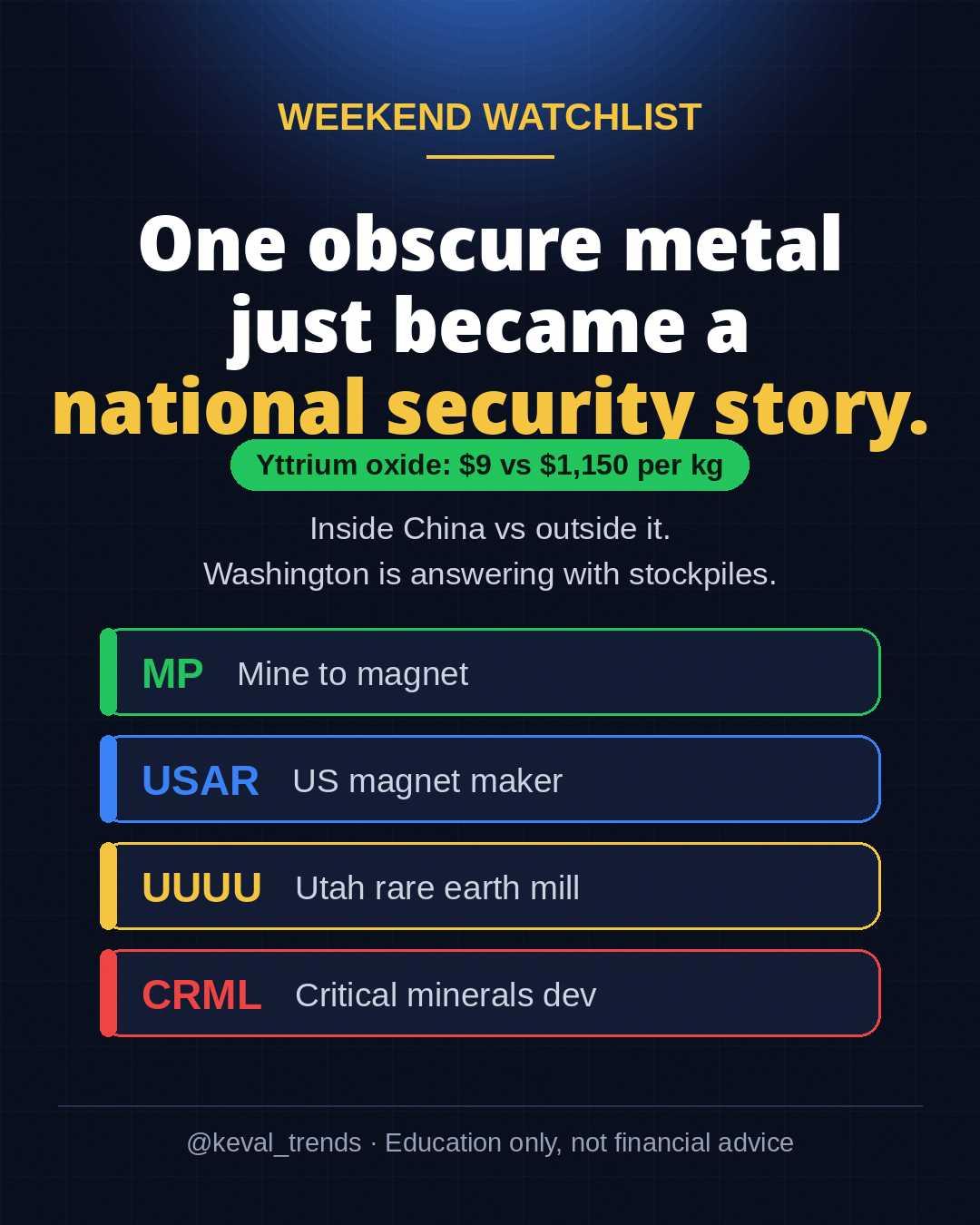
Yttrium Oxide: A National Security Concern
One metal most people have never heard of is now a national security story.
Yttrium oxide costs about $9 a kilogram inside China and about $1,150 outside it, according to Argus data reported by the Financial Times. Japan, which relies on it for jet engines and chipmaking equipment, could run short within months after Chinese shipments to Japan fell 97.7% in January to May 2026.
Washington is responding with stockpiles, not just speeches. Project Vault, announced in February, pairs a $10 billion Export-Import Bank loan with about $2 billion in private money to build a strategic critical minerals reserve. The first manufacturer loans, up to $1 billion, are reportedly imminent.
Here are 4 worth researching. 👇
📌 The Watchlist
1. MP Materials | $MP: Runs the Mountain Pass rare earth mine in California and makes magnets in Texas. The Pentagon took a $400 million stake in July 2025 and set a 10 year, $110 per kilogram price floor on its key magnet oxide. Apple also signed a $500 million magnet deal with MP.
2. USA Rare Earth | $USAR: Builds neodymium magnets in the US and is constructing a magnet plant in Stillwater, Oklahoma. Its shares jumped about 16% when Project Vault was unveiled, and it has reportedly discussed $1.6 billion in federal support.
3. Energy Fuels | $UUUU: Runs the White Mesa Mill in Utah, the only operating conventional uranium mill in the US, now producing separated rare earth oxides from monazite. It is building a roughly $104 million expansion for large scale heavy rare earth oxide production.
4. Critical Metals Corp | $CRML: US listed critical minerals developer focused on building non-China supply. Its shares jumped with the rest of the sector when Project Vault reports hit the tape.
📌 The Part Worth Saving
A government stockpile is a reason to research a stock. It is not a reason to buy blindly.
Look for:
- Real production or processing, not just a mining claim
- Long term contracts or price floors that survive a price drop
- Cash to finish construction without endless dilution
- A refining step, because ore without refining is still a bottleneck
The best question: if China refines close to 99% of the world's heavy rare earths, which of these companies actually closes the refining gap first?
Education only, not financial advice.