Retiring Early? The Order of Market Returns MatterIn Episode 29 of Financial KarMoe @karyungtom and I kick things off with a little hockey talk, including how the Edmonton Oilers, Montreal Canadiens and Vancouver Canucks have been doing so far this season, before diving into two important topics for Canadian investors. 🏒📈 We take a closer look at BMO's new $ZALL ETF (BMO MSCI All Country World Index ETF). What makes this fund different from the traditional all-in-one ETFs like $XEQT? We discuss global market-cap weighting, Canadian home-country bias, the fund's significant US exposure, and whether having a portfolio that reflects the actual size of global stock markets makes sense. We also touch on why some investors have been looking for a simpler way to get globally diversified equity exposure without having to manage multiple ETFs. Next, we get into something particularly important for anyone thinking about financial independence or early retirement: sequence of returns risk. What happens if the stock market delivers its worst returns during the first few years of your retirement? Can two investors earn the exact same average annual return but end up with dramatically different retirement outcomes simply because the order of those returns is different? Kar walks us through some fascinating retirement simulations using his calculator, including scenarios where a $1 million portfolio with a $40,000 annual withdrawal can run out of money in one sequence but continue growing in another. We discuss withdrawal rates, the 4% rule, cash wedges, dynamic withdrawals and whether keeping money outside the market is worth the potential opportunity cost. We also explore how pensions, CPP, alternative income sources and adjusting discretionary spending can help manage retirement risk. And importantly, we discuss why planning for early retirement isn't just about reaching a portfolio number. It's also about understanding what you're retiring to, what you might be giving up, and whether your retirement lifestyle is actually what you envision. We wrap up with a discussion about return of capital (ROC), how it affects adjusted cost base (ACB) in non-registered accounts, and why understanding the tax treatment matters. As always, we appreciate your questions and comments on YouTube and Blossom. We hope you enjoy the discussion! Question for you: If you were retiring tomorrow, would you keep 1-2 years of expenses in cash to protect against a market downturn, or would you prefer to stay fully invested and adjust your withdrawals when needed? Let us know in the comments! 👇 Thanks for watching and supporting Financial KarMoe! 🙏🏼 https://www.youtube.com/watch?v=MF9X7KiKeKE32 reactions • 14 comments
@mahyar • 10d
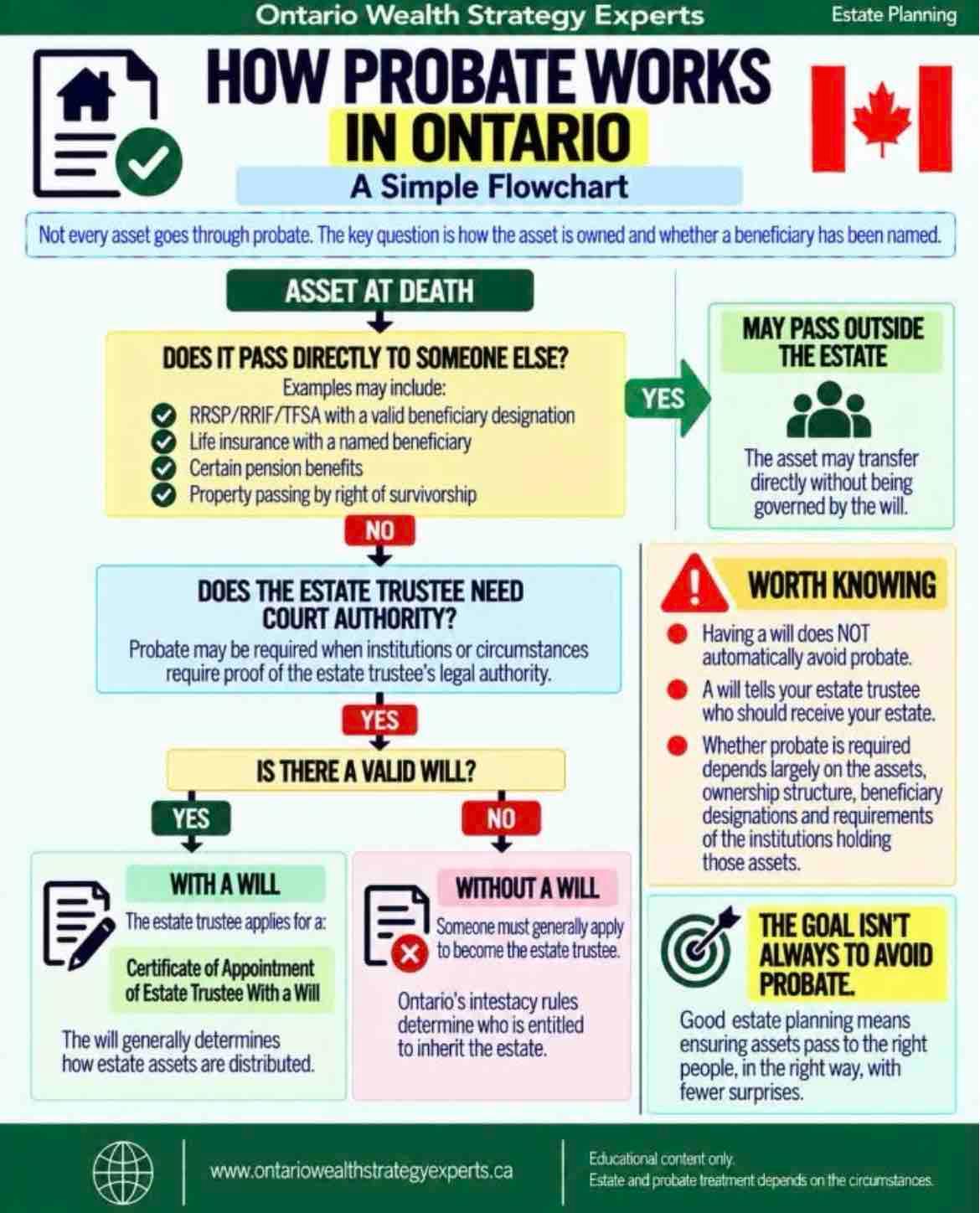
Does a Will Skip Probate in Ontario? 🇨🇦— A lot of investors think having a will automatically skips probate. It actually doesn't! When we spend years building up our portfolios, we want to make sure our money goes to the right people without extra headaches or delays. Here is how it actually works in 🇨🇦 Ontario: 1. What usually skips probate? - Named Beneficiaries: Your TFSA, RRSP, RRIF, or life insurance with a valid beneficiary designation typically passes directly to that person outside your estate. - Joint Accounts (Between Spouses): Joint bank accounts and joint non-registered margin accounts set up with Right of Survivorship generally pass directly to your spouse without probate. Note: Adding an adult child to a joint account doesn't automatically skip probate in Ontario unless there's clear proof it was meant as a true gift, not held in trust. 2. What goes through probate? Solo bank accounts, solo real estate, or solo non-registered accounts usually need court authority (probate) before your trustee can touch them, even if you have a valid will. Without a will, the province steps in with strict rules to decide who gets what. Good to know - Facts for Ontario Investors: 1. Joint accounts do not skip taxes. Unless it passes to a spouse, the CRA still treats your death as a "deemed disposition," meaning capital gains on your share of ETFs or stocks are taxed on your final return. 2. In Ontario, probate fees are called Estate Administration Tax. The first $50,000 is free ($0), but everything above that is taxed at 1.5% ($15 per $1,000). A $500,000 solo non-registered portfolio triggers $6,750 in probate fees! Whether you're holding broad ETFs like $XEQT and $VFV in your TFSA, or building a dividend portfolio with $SCHD and $VDY in a joint non-registered account, how you hold those assets matters just as much as what you buy. Have you double-checked your beneficiary and joint account settings lately? If not, it is time to visit. — This is for informational and educational purposes only. 17 reactions • 6 comments
@livingmylife • 15d
Master of our destiny - RRSP for life. Encouraged by the recent post by @retired "Financial Freedom, Not lipstick on a Pig" and comments by @ffcatherine I want to encourage our community to provide feedback on the 2026 Budget RRSP for life proposal. The request the Canadian Government for public consultation, provides us with a rare opportunity to potentially influence public policy. Feedback can be sent by individuals to the Department of Finance Canada, Official consultation email RRSP-consultation-REER@fin.gc.ca I'm going to do something very hard for me and provide my letter for feedback and I appreciate feedback before I sent it. (I know its long so... happy reading) Re: Budget 2026, Consultation on RRSP-for-Life. I am writing as a Canadian taxpayer, senior and long-term retirement saver to provide my perspective on the proposed RRSP-for-Life initiative. The theme of Budget 2026, “Masters of Our Destiny,” resonates with me. The government's vision of Canadians taking greater control of our country's economic future raises the equally important question of should Canadians not also have greater control over their own financial futures, particularly in retirement? Any time a system is streamlined to eliminate complexity, it is a good thing and for that reason I support the government's efforts to simplify the administration of RRSPs and RRIFs. Eliminating unnecessary account conversions and paperwork is a positive step. However, I believe this consultation presents an opportunity to address a much more important issue which is an opportunity to allow Canadians greater control over their retirement savings so they can maintain their financial independence throughout their later years. Retirement savings should support aging in place Throughout my working life, I have made conscious financial decisions and personal sacrifices to save for retirement. My parents taught me the importance of saving, planning for the future and taking responsibility for my own financial well-being. My objective was never simply to accumulate money. It was to ensure that my husband and I would have the financial resources to care for ourselves as we aged. Like many Canadians, I hope to remain in my own home for as long as possible. That may eventually mean paying for housekeeping, transportation, home modifications, personal assistance or substantial in-home care. The cost of retirement does not necessarily decline as we age. Our needs change, and our retirement savings should be flexible enough to change with them. Under the existing RRIF rules, mandatory withdrawal percentages increase with age, regardless of an individual's circumstances or anticipated future care needs. I question whether requiring retirees to withdraw increasingly large amounts from their registered investments is consistent with encouraging them to preserve sufficient resources to remain independent. I encourage the government to examine whether greater flexibility could help Canadians finance their own care and potentially reduce future demand for publicly funded institutional care. Reconsider mandatory RRIF withdrawals I recognize that RRSPs provide tax deferral and that government has a legitimate interest in eventually collecting the taxes owing on these savings. I am not advocating that RRSP withdrawals become tax-free. Rather, I believe Canadians should have greater control over when they withdraw their savings, based on their individual circumstances, financial needs and expectations for later life. I would like the government to seriously consider eliminating mandatory minimum withdrawal percentages. I also recognize that leaving substantial registered assets until death could result in a significant tax liability for an estate, subject to existing rollover provisions. I consider that a legitimate consideration in retirement planning. My priority, however, is having the financial resources available during my lifetime, particularly if I need expensive care in my later years. A policy focused on retirement security should recognize that preserving financial independence during life may be more important to some Canadians than maximizing the value of their estates. Recognize the financial vulnerability of surviving spouses Another important consideration is the financial impact of losing a spouse. Women, on average, live longer than men and are more likely to spend part of their retirement as widows. When a spouse dies, household income can decline, eligible pension-income splitting is generally no longer available in subsequent taxation years, and the surviving spouse may become responsible for maintaining the household alone. At the same time, I believe their need for paid assistance may increase. My husband and I have a significant age difference, and when his RRIF was originally established, I was still working. We were not aware of the ability to use my younger age to determine his minimum withdrawals. Experiences such as ours demonstrate that decisions made at one stage of retirement may not reflect a couple's circumstances many years later. I would encourage the government to consider greater flexibility for surviving spouses and couples with significant age differences, including the opportunity to reconsider withdrawal arrangements as their circumstances change. Preserve investments and reduce unnecessary administrative barriers One advantage of keeping retirement savings in a registered account is that investments can continue growing on a tax-deferred basis while remaining clearly designated for retirement. Once money is withdrawn, it is subject to tax, require reinvestment in another account and potentially becomes more readily available for discretionary spending. Although in-kind RRIF withdrawals are permitted, my personal experience has been that financial institutions can be reluctant to facilitate them. I would encourage the government to examine whether the proposed reforms could establish clearer requirements for financial institutions to accommodate in-kind transfers, disclose restrictions and fees, and simplify the process for account holders. I would also ask that Canadians who have already converted their RRSPs to RRIFs be considered in the implementation of any new arrangements. Strengthen financial literacy and encourage a culture of saving I also believe this consultation should consider how Canada can encourage more people to save strategically throughout their working lives. Financial responsibility begins with education and example. I recently spoke with a young person who was deliberately reducing small discretionary purchases to invest regularly in a diversified exchange-traded fund. I found this encouraging because it demonstrated an understanding of consistent saving, delayed gratification and long-term planning. Not every Canadian has the same financial capacity to save. Nevertheless, I believe we should do more to ensure that people understand the opportunities available to them through RRSPs, TFSAs and other savings vehicles. Financial literacy should include practical education about compound growth, investment costs, retirement taxation, CPP, OAS, pension-income splitting and strategies for drawing down savings and we need public education to address this gap. The theme of being “masters of our destiny” should apply not only to Canada's national economic future but also to empowering individual Canadians with the knowledge and confidence to build their own financial security. It would be wonderful if all Canadians were encouraged to gain the knowledge and responsibility to save throughout their working lives to accumulate retirement savings and then provided with the flexibility to manage those savings responsibly through retirement. Examine the broader financial and social consequences Finally, I encourage the Department of Finance to publish an analysis of the proposed reforms, including: How many Canadians would experience a meaningful financial benefit, rather than only administrative simplification? What would be the tax-revenue implications of reducing or eliminating mandatory withdrawal requirements? Could greater withdrawal flexibility improve retirement security, particularly for surviving spouses and people planning for substantial late-life care expenses? Could increased financial independence help some Canadians remain in their homes longer? How might greater control over retirement savings affect the willingness of younger Canadians to save? I recognize that there are competing tax and policy considerations, and that changes must be assessed for fairness across income groups and generations. However, I believe there is an opportunity to look beyond account administration and consider the broader purpose of Canada's retirement savings system. Closing thoughts Retirement savings should be there to support Canadians when they need them most, not simply distributed according to a prescribed schedule based on age. Canadians who have spent decades saving for retirement should be able to make informed decisions about how those savings support their changing circumstances, particularly as they face the possibilities of widowhood, increasing care needs and longer lifespans. I support simplifying the RRSP and RRIF system. But I encourage the government to take this opportunity to examine reforms that genuinely improve retirement security, promote financial literacy and give Canadians greater control over their financial independence. Thank you for providing Canadians with an opportunity to contribute to this consultation. I appreciate your consideration of these views. 2 reactions • 4 comments
@akshey • 2d
Your TFSA gets $500 more room in January🇨🇦💰 Good news for 2027. Your TFSA limit goes up to $7,500, from $7,000 this year. 📈 First bump since 2024. It sat at $7,000 for three years. Inflation indexing finally pushed it over the line. 🧮 Lifetime room is now $116,500. That is everything since 2009, for someone eligible every year who never contributed. 🔍 One honesty note. The CRA posts the official table in late November. But the formula already settles it, so I am planning on $7,500. Three moves before January 1: 1️⃣ Do not contribute the new $500 in December. The room only exists on January 1. Jump the gun and the CRA charges 1% a month on the excess. 2️⃣ Check your 2026 withdrawals. Anything you took out this year comes back as room on January 1, on top of the $7,500. 3️⃣ Set your first buy for January. My plan is simple: $XEQT. New room, same boring buy. Small raise. Big habit. That is the whole point of a TFSA.20 reactions • 0 comments
@seahawkselector • 14d
Quick question. I have x2 TFSA accounts and wish to simplify to have x1. if I withdraw the $20k in my 2nd account in December. I assume that the full $20k can be put into my primary account in January without sacrificing any contribution space? and put my $7k in for 2027? 0 reactions • 4 comments
💰 Good news for 2027. Your TFSA limit goes up to $7,500, from $7,000 this year. 📈 First bump since 2024. It sat at $7,000 for three years. Inflation indexing finally pushed it over the line. 🧮 Lifetime room is now $116,500. That is everything since 2009, for someone eligible every year who never contributed. 🔍 One honesty note. The CRA posts the official table in late November. But the formula already settles it, so I am planning on $7,500. Three moves before January 1: 1️⃣ Do not contribute the new $500 in December. The room only exists on January 1. Jump the gun and the CRA charges 1% a month on the excess. 2️⃣ Check your 2026 withdrawals. Anything you took out this year comes back as room on January 1, on top of the $7,500. 3️⃣ Set your first buy for January. My plan is simple: $XEQT. New room, same boring buy. Small raise. Big habit. That is the whole point of a TFSA.read more
Encouraged by the recent post by @retired "Financial Freedom, Not lipstick on a Pig" and comments by @ffcatherine I want to encourage our community to provide feedback on the 2026 Budget RRSP for life proposal. The request the Canadian Government for public consultation, provides us with a rare opportunity to potentially influence public policy. Feedback can be sent by individuals to the Department of Finance Canada, Official consultation email RRSP-consultation-REER@fin.gc.ca I'm going to do something very hard for me and provide my letter for feedback and I appreciate feedback before I sent it. (I know its long so... happy reading) Re: Budget 2026, Consultation on RRSP-for-Life. I am writing as a Canadian taxpayer, senior and long-term retirement saver to provide my perspective on the proposed RRSP-for-Life initiative. The theme of Budget 2026, “Masters of Our Destiny,” resonates with me. The government's vision of Canadians taking greater control of our country's economic future raises the equally important question of should Canadians not also have greater control over their own financial futures, particularly in retirement? Any time a system is streamlined to eliminate complexity, it is a good thing and for that reason I support the government's efforts to simplify the administration of RRSPs and RRIFs. Eliminating unnecessary account conversions and paperwork is a positive step. However, I believe this consultation presents an opportunity to address a much more important issue which is an opportunity to allow Canadians greater control over their retirement savings so they can maintain their financial independence throughout their later years. Retirement savings should support aging in place Throughout my working life, I have made conscious financial decisions and personal sacrifices to save for retirement. My parents taught me the importance of saving, planning for the future and taking responsibility for my own financial well-being. My objective was never simply to accumulate money. It was to ensure that my husband and I would have the financial resources to care for ourselves as we aged. Like many Canadians, I hope to remain in my own home for as long as possible. That may eventually mean paying for housekeeping, transportation, home modifications, personal assistance or substantial in-home care. The cost of retirement does not necessarily decline as we age. Our needs change, and our retirement savings should be flexible enough to change with them. Under the existing RRIF rules, mandatory withdrawal percentages increase with age, regardless of an individual's circumstances or anticipated future care needs. I question whether requiring retirees to withdraw increasingly large amounts from their registered investments is consistent with encouraging them to preserve sufficient resources to remain independent. I encourage the government to examine whether greater flexibility could help Canadians finance their own care and potentially reduce future demand for publicly funded institutional care. Reconsider mandatory RRIF withdrawals I recognize that RRSPs provide tax deferral and that government has a legitimate interest in eventually collecting the taxes owing on these savings. I am not advocating that RRSP withdrawals become tax-free. Rather, I believe Canadians should have greater control over when they withdraw their savings, based on their individual circumstances, financial needs and expectations for later life. I would like the government to seriously consider eliminating mandatory minimum withdrawal percentages. I also recognize that leaving substantial registered assets until death could result in a significant tax liability for an estate, subject to existing rollover provisions. I consider that a legitimate consideration in retirement planning. My priority, however, is having the financial resources available during my lifetime, particularly if I need expensive care in my later years. A policy focused on retirement security should recognize that preserving financial independence during life may be more important to some Canadians than maximizing the value of their estates. Recognize the financial vulnerability of surviving spouses Another important consideration is the financial impact of losing a spouse. Women, on average, live longer than men and are more likely to spend part of their retirement as widows. When a spouse dies, household income can decline, eligible pension-income splitting is generally no longer available in subsequent taxation years, and the surviving spouse may become responsible for maintaining the household alone. At the same time, I believe their need for paid assistance may increase. My husband and I have a significant age difference, and when his RRIF was originally established, I was still working. We were not aware of the ability to use my younger age to determine his minimum withdrawals. Experiences such as ours demonstrate that decisions made at one stage of retirement may not reflect a couple's circumstances many years later. I would encourage the government to consider greater flexibility for surviving spouses and couples with significant age differences, including the opportunity to reconsider withdrawal arrangements as their circumstances change. Preserve investments and reduce unnecessary administrative barriers One advantage of keeping retirement savings in a registered account is that investments can continue growing on a tax-deferred basis while remaining clearly designated for retirement. Once money is withdrawn, it is subject to tax, require reinvestment in another account and potentially becomes more readily available for discretionary spending. Although in-kind RRIF withdrawals are permitted, my personal experience has been that financial institutions can be reluctant to facilitate them. I would encourage the government to examine whether the proposed reforms could establish clearer requirements for financial institutions to accommodate in-kind transfers, disclose restrictions and fees, and simplify the process for account holders. I would also ask that Canadians who have already converted their RRSPs to RRIFs be considered in the implementation of any new arrangements. Strengthen financial literacy and encourage a culture of saving I also believe this consultation should consider how Canada can encourage more people to save strategically throughout their working lives. Financial responsibility begins with education and example. I recently spoke with a young person who was deliberately reducing small discretionary purchases to invest regularly in a diversified exchange-traded fund. I found this encouraging because it demonstrated an understanding of consistent saving, delayed gratification and long-term planning. Not every Canadian has the same financial capacity to save. Nevertheless, I believe we should do more to ensure that people understand the opportunities available to them through RRSPs, TFSAs and other savings vehicles. Financial literacy should include practical education about compound growth, investment costs, retirement taxation, CPP, OAS, pension-income splitting and strategies for drawing down savings and we need public education to address this gap. The theme of being “masters of our destiny” should apply not only to Canada's national economic future but also to empowering individual Canadians with the knowledge and confidence to build their own financial security. It would be wonderful if all Canadians were encouraged to gain the knowledge and responsibility to save throughout their working lives to accumulate retirement savings and then provided with the flexibility to manage those savings responsibly through retirement. Examine the broader financial and social consequences Finally, I encourage the Department of Finance to publish an analysis of the proposed reforms, including: How many Canadians would experience a meaningful financial benefit, rather than only administrative simplification? What would be the tax-revenue implications of reducing or eliminating mandatory withdrawal requirements? Could greater withdrawal flexibility improve retirement security, particularly for surviving spouses and people planning for substantial late-life care expenses? Could increased financial independence help some Canadians remain in their homes longer? How might greater control over retirement savings affect the willingness of younger Canadians to save? I recognize that there are competing tax and policy considerations, and that changes must be assessed for fairness across income groups and generations. However, I believe there is an opportunity to look beyond account administration and consider the broader purpose of Canada's retirement savings system. Closing thoughts Retirement savings should be there to support Canadians when they need them most, not simply distributed according to a prescribed schedule based on age. Canadians who have spent decades saving for retirement should be able to make informed decisions about how those savings support their changing circumstances, particularly as they face the possibilities of widowhood, increasing care needs and longer lifespans. I support simplifying the RRSP and RRIF system. But I encourage the government to take this opportunity to examine reforms that genuinely improve retirement security, promote financial literacy and give Canadians greater control over their financial independence. Thank you for providing Canadians with an opportunity to contribute to this consultation. I appreciate your consideration of these views. read more
Quick question. I have x2 TFSA accounts and wish to simplify to have x1. if I withdraw the $20k in my 2nd account in December. I assume that the full $20k can be put into my primary account in January without sacrificing any contribution space? and put my $7k in for 2027?
This past month I opened a Roth IRA and have been contributing $20 a week every Friday, plus any spare change I have when the market takes a dip. But here’s my plan to make it profitable. Strategy: 1. Price point 15 individual long term growth stocks 2. Price point 4 ETF stocks 3. Requirements: all stocks and ETFs must have a 120% or higher 5 year growth. 4. Goal: buy ETF’s on market dips and individual stocks on individual dips. Here are the stocks I plan on adding to my ROTH IRA portfolio: ETFs: $SMH$VOO$VDE$VGT Individual Stocks: $GOOGL$META$LLY$HLT$TSM$XOM and the rest still undecided. Let me know what stocks you recommend for a Roth IRA. read more
Hey everyone. I have come into some $$ and was wondering what others would do. I have $20k that I am going to be putting into my TFSA which is strictly for retirement in 20 years. Currently my holdings are T.to, ENB, CNR, TD, REI-UN and XEQT. My idea was to throw 100% of it into XEQT. What would you do? XEQT? Another current or new holding? Thank you in advance.
In Episode 29 of Financial KarMoe @karyungtom and I kick things off with a little hockey talk, including how the Edmonton Oilers, Montreal Canadiens and Vancouver Canucks have been doing so far this season, before diving into two important topics for Canadian investors. 🏒📈 We take a closer look at BMO's new $ZALL ETF (BMO MSCI All Country World Index ETF). What makes this fund different from the traditional all-in-one ETFs like $XEQT? We discuss global market-cap weighting, Canadian home-country bias, the fund's significant US exposure, and whether having a portfolio that reflects the actual size of global stock markets makes sense. We also touch on why some investors have been looking for a simpler way to get globally diversified equity exposure without having to manage multiple ETFs. Next, we get into something particularly important for anyone thinking about financial independence or early retirement: sequence of returns risk. What happens if the stock market delivers its worst returns during the first few years of your retirement? Can two investors earn the exact same average annual return but end up with dramatically different retirement outcomes simply because the order of those returns is different? Kar walks us through some fascinating retirement simulations using his calculator, including scenarios where a $1 million portfolio with a $40,000 annual withdrawal can run out of money in one sequence but continue growing in another. We discuss withdrawal rates, the 4% rule, cash wedges, dynamic withdrawals and whether keeping money outside the market is worth the potential opportunity cost. We also explore how pensions, CPP, alternative income sources and adjusting discretionary spending can help manage retirement risk. And importantly, we discuss why planning for early retirement isn't just about reaching a portfolio number. It's also about understanding what you're retiring to, what you might be giving up, and whether your retirement lifestyle is actually what you envision. We wrap up with a discussion about return of capital (ROC), how it affects adjusted cost base (ACB) in non-registered accounts, and why understanding the tax treatment matters. As always, we appreciate your questions and comments on YouTube and Blossom. We hope you enjoy the discussion! Question for you: If you were retiring tomorrow, would you keep 1-2 years of expenses in cash to protect against a market downturn, or would you prefer to stay fully invested and adjust your withdrawals when needed? Let us know in the comments! 👇 Thanks for watching and supporting Financial KarMoe! 🙏🏼 https://www.youtube.com/watch?v=MF9X7KiKeKEread more
— A lot of investors think having a will automatically skips probate. It actually doesn't! When we spend years building up our portfolios, we want to make sure our money goes to the right people without extra headaches or delays. Here is how it actually works in 🇨🇦 Ontario: 1. What usually skips probate? - Named Beneficiaries: Your TFSA, RRSP, RRIF, or life insurance with a valid beneficiary designation typically passes directly to that person outside your estate. - Joint Accounts (Between Spouses): Joint bank accounts and joint non-registered margin accounts set up with Right of Survivorship generally pass directly to your spouse without probate. Note: Adding an adult child to a joint account doesn't automatically skip probate in Ontario unless there's clear proof it was meant as a true gift, not held in trust. 2. What goes through probate? Solo bank accounts, solo real estate, or solo non-registered accounts usually need court authority (probate) before your trustee can touch them, even if you have a valid will. Without a will, the province steps in with strict rules to decide who gets what. Good to know - Facts for Ontario Investors: 1. Joint accounts do not skip taxes. Unless it passes to a spouse, the CRA still treats your death as a "deemed disposition," meaning capital gains on your share of ETFs or stocks are taxed on your final return. 2. In Ontario, probate fees are called Estate Administration Tax. The first $50,000 is free ($0), but everything above that is taxed at 1.5% ($15 per $1,000). A $500,000 solo non-registered portfolio triggers $6,750 in probate fees! Whether you're holding broad ETFs like $XEQT and $VFV in your TFSA, or building a dividend portfolio with $SCHD and $VDY in a joint non-registered account, how you hold those assets matters just as much as what you buy. Have you double-checked your beneficiary and joint account settings lately? If not, it is time to visit. — This is for informational and educational purposes only. read more
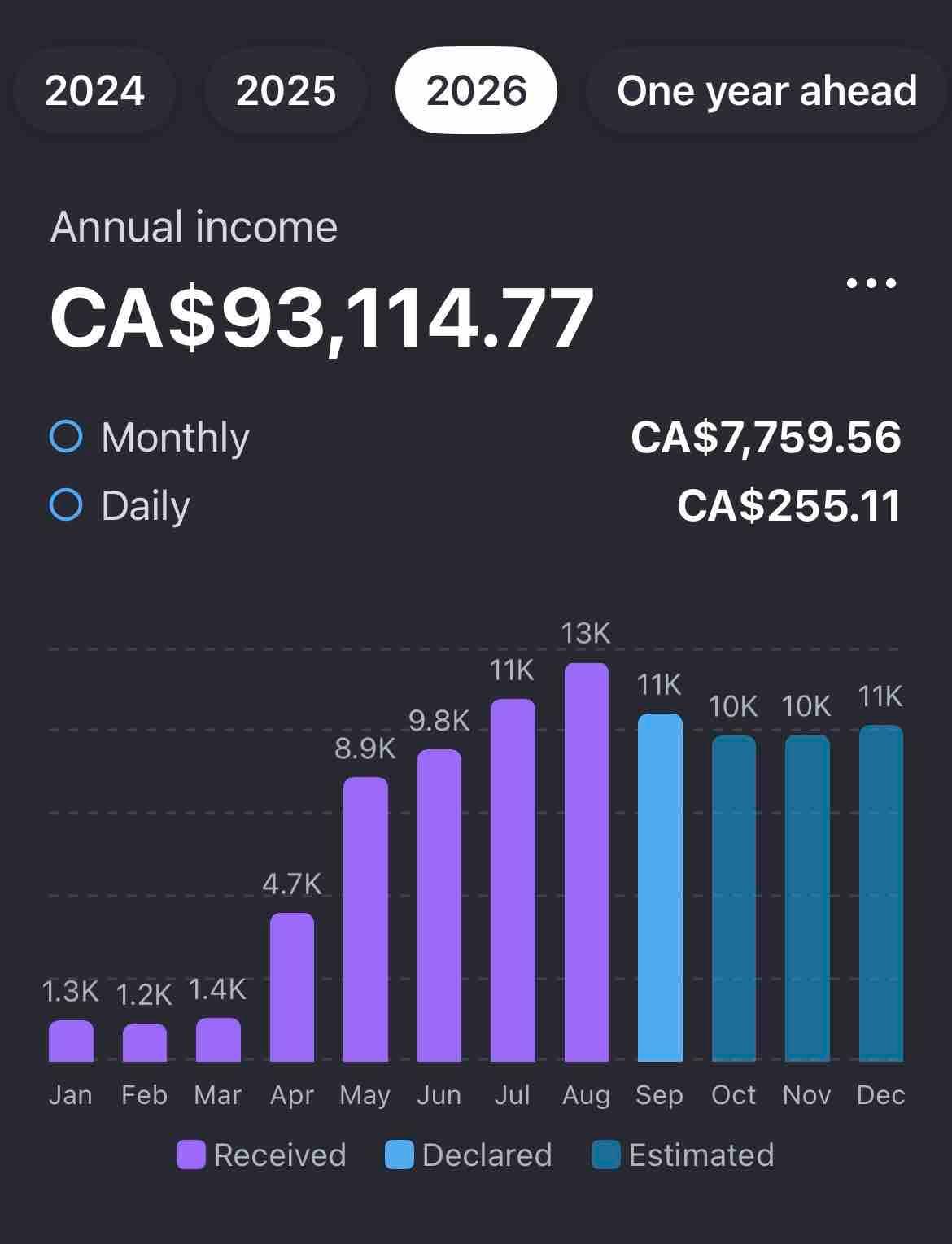
Coming to end of August, it will be 6 months since I got let go from work and decided to take steps towards retirement and transition to CC-ETF’s. 70% of my portfolio is now in covered call ETF’s and generating decent monthly income to make me realize this will work and I can just retire. All income is in my RRSP and TFSA so tax free. Will have to start withdrawing next year but for now am reinvesting all distributions. In process did made some mistakes but that’s the process. Learned a lot from blossom community and videos that some of you are so generous to create and share. Thankyou for that.
Is it actually possible to retire at 48 in Canada—while buying a $500k home along the way? 🤔 5 years ago, I didn't set financial goals. I just went with the flow. But once I put pen to paper and built a structured plan, everything changed. Here is my exact 20-Year Financial Blueprint (with real numbers, registered accounts, and monthly contributions): 1️⃣ Goal 1: $100k Net Canadian Portfolio (Target: Dec 2026) • Current Status: Sitting at ~$96k across TFSA ($13k), FHSA ($25k), and RRSP. • Strategy: Daily automated contributions (~$3k/month). Less than $4k left to go! 2️⃣ Goal 2: $500k Combined Portfolio — Canada & India (Target: Dec 2031) • Cross-Border Split: 85% CAD/US equities + 15% Indian equities (~$600 CAD/mo into INR). • Total Monthly Contribution: ~$3,600/month across both markets to leverage dual-market growth & dollar-cost average currency risk. 3️⃣ Goal 3: Buy a $500k Home in Canada (Target: Dec 2027) • Down Payment: 10% ($50k) + $10k closing costs = $60k target. • Account Strategy: Maxing FHSA (tax-free growth & withdrawals) + leveraging the RRSP Home Buyers’ Plan (HBP) for an interest-free loan from myself. 4️⃣ Goal 4: Retire at Age 48 with $1.5M FIRE Number • The Math: $60k/year expenses ($5k/mo) × 25 (4% Rule) = $1.5M FIRE target. • The Bridge: Combining equity growth with a paid-off primary residence for tax-free housing capital in retirement. 👇 I want to hear from you: What is your #1 money goal for the next 5 years? Are you prioritizing index fund growth, stacking cash for real estate, or going all-in on tax-advantaged accounts? Let’s hold each other accountable in the comments! 💬 #CanadianInvesting #PersonalFinance #TFSA #RRSP #FHSA #FinancialIndependence #FIREMovement #CrossBorderInvesting #InvestingGoals #RealEstateCanada 🎥 Watch the full 20-minute video breakdown on YouTube: https://www.youtube.com/watch?v=uNCp-6jne84read more


 @moementumfinance • 7d
 @mahyar • 10d
 @livingmylife • 15d
 @akshey • 2d
 @seahawkselector • 14d