Do You Benchmark Your Portfolio?
Nine months into 2026, it has been a volatile year in the markets. Tariffs, trade wars, actual wars, and the constant talk of an AI bubble bursting have given investors a lot to think about.
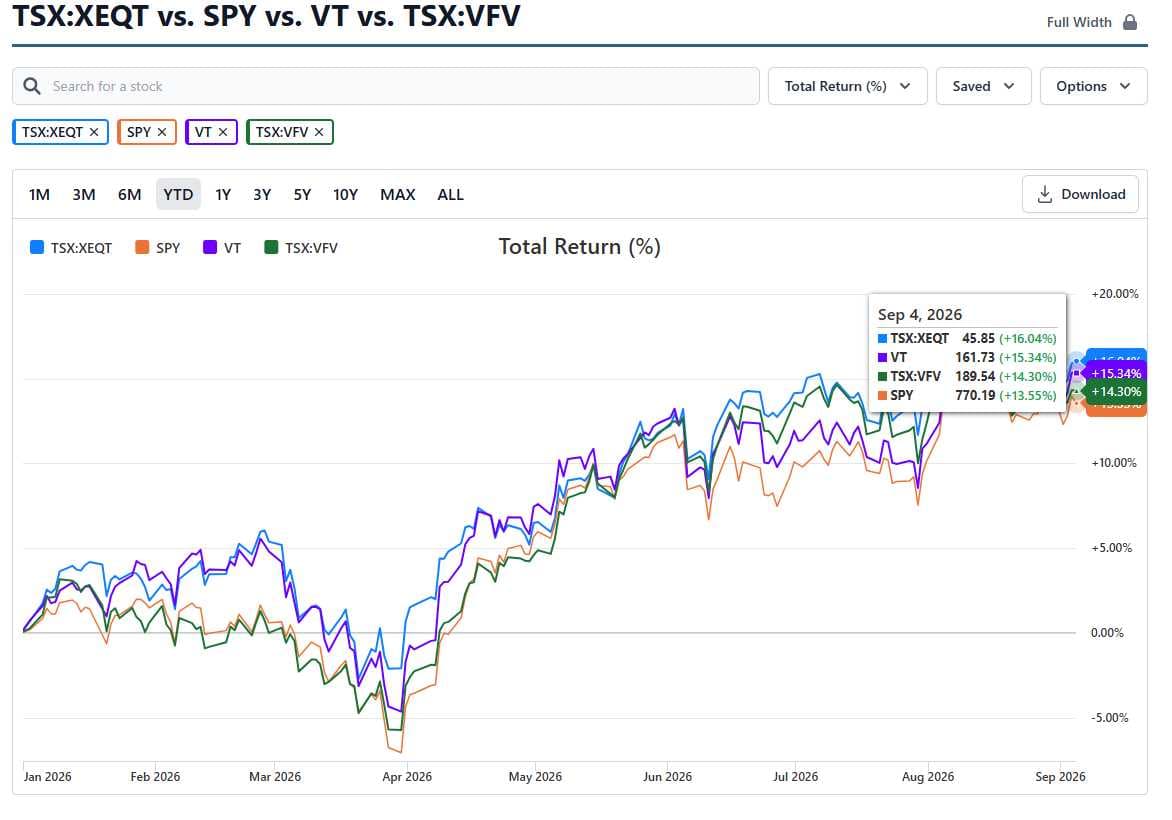
Given how many DIY investors are on a platform like this, I’m curious: do you actually measure your portfolio’s performance? And if you do, what do you compare it against? A broad-based index like VT, XEQT, or the S&P like VFV, or SPY?
It is easy to log in to your broker, look at your portfolio, and see how much income it generated or how much the account balance changed. But that does not necessarily tell you how well your investment strategy actually performed.
A benchmark helps answer the question: Did all the decisions I made produce a better or worse result than simply putting the money into a broad-market index?
That does not mean every part of your portfolio needs to beat an equity index. Most portfolios are built with different pieces for different reasons. You may hold fixed income or cash because you want lower volatility or liquidity. You may have an income sleeve designed to generate cash flow even if you know it could give up some upside. Someone in retirement may care much more about protecting their nest egg and producing dependable cash flow than squeezing every last percentage point of return out of their portfolio.
Many investors will say they are willing to accept a lower total return if they are getting something in exchange for it. But how much lower are they willing to take? If your portfolio trails the benchmark by 1%, you may look at everything your strategy gives you and decide that is a very reasonable trade-off. If the gap is 3%, 5%, or more year after year, you may start looking at it very differently. Saying you are willing to give up some return is easy. Knowing exactly how much return you are giving up is what tells you whether the trade-off actually makes sense. If you never compare your results against anything, you do not really know how much you are giving up to get it.
So for the DIY investors here, I’m curious: do you track your performance, and what benchmark do you use?