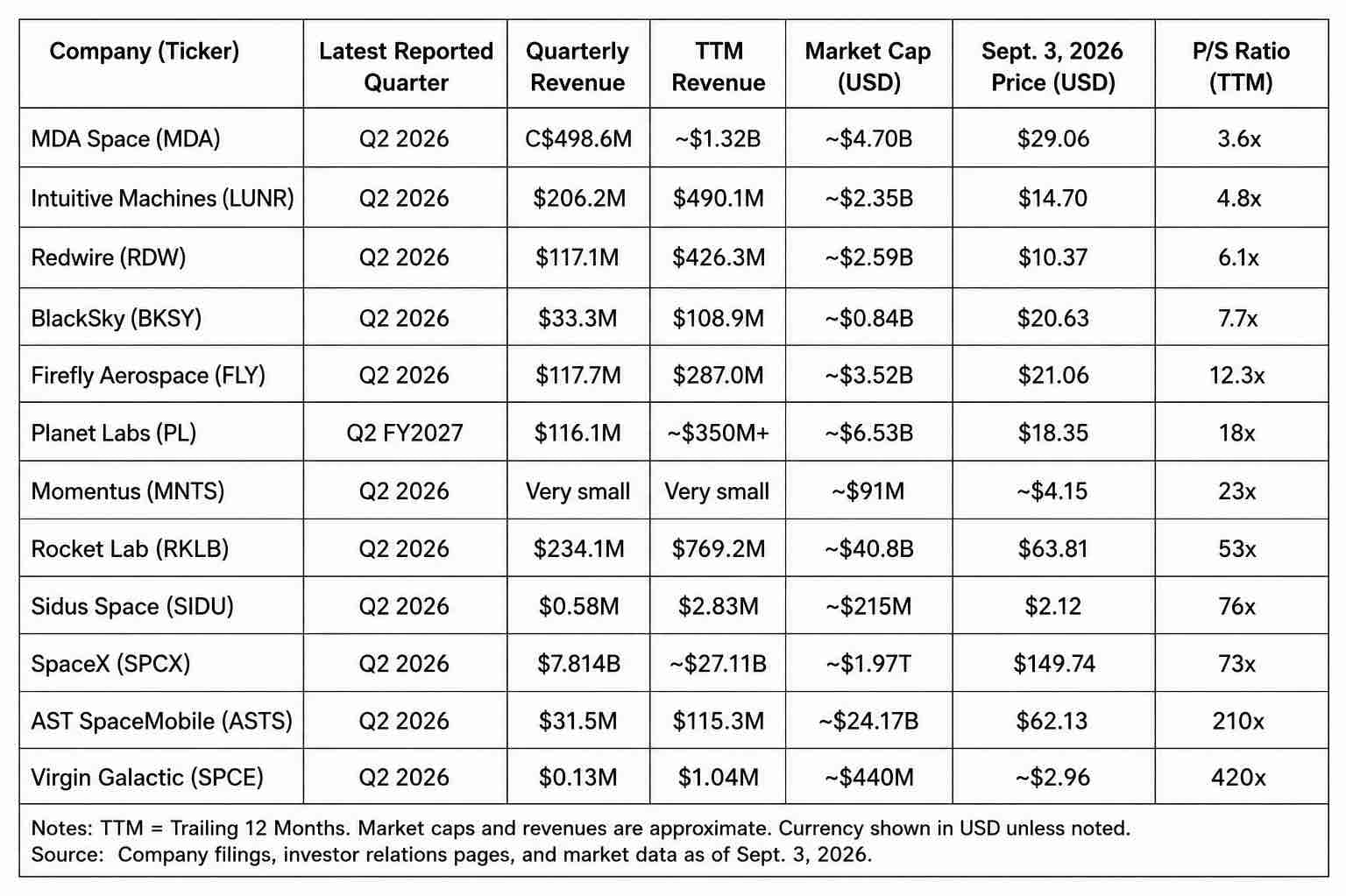
I like using the P/S ratio when comparing space stocks, given that most of them are still unprofitable. Of course other metrics are important but that’s for my second-stage analysis to look at debt, etc. That said, in a cash-intensive industry like space, I find the P/S metric particularly useful because it puts the company’s valuation in the context of the revenue it is actually generating and I think it’s also a way to think about how much execution is kind of factored in the valuation given most revenue is driven by contracts. Case 1: A space company can have multiple billions in backlog, but if they can’t execute, that surely increases the P/S. The stock can plummet 90% the P/S would still be high because at some point the company can’t execute anymore (hello $SPCE at 420x P/S) Case 2: A company may execute super well, but the stock trades at a very high valuation because investors factor in future growth e.g. $ASTS when the constellation is up and running or $RKLB when Neutron becomes operational. The thesis relies therefore on the company’s execution to justify that P/S. $LUNR is guiding for ~$1B in revenue this year. At its current ~$2.35B market cap, that implies a ~2.35x forward P/S ratio. That’s one of the reasons I currently hold $LUNR at ~35% of my portfolio, followed by $MDA also trading at a juicy P/S. Execution is not the rationale behind my switch from $RKLB to $PL. I’ll explain that in detail tomorrow 👀 On a trailing-twelve-month basis, some of the space companies currently trading at the lowest P/S multiples include $MDA, $LUNR, and $RDW. In the other hand, some of the highest P/S multiples are $SPCX, $ASTS, and $SPCE.
5,378 views
19 Comments
pantaleo ruocco@noxvale · 16d
Interesting analysis Anthony, as always! 🫵🏻🚀
Jessica @crowsnestjess · 16d
Amazing how high PL was in the spring! It will come back.
Jared LaMarsh@nettspend · 15d
so impressive
Jacob Smith@smith132 · 15d
I hold spce rdw and asts!!!
See the full comment section 👀Sign up for the full Blossom experience!