The more and more I dive into this industry the more I think that these humanoid robots are going to be a massive market. Obviously $TSLA seems like the big obvious play but what other companies are on your radar for exposure to this industry? Personally I am doing research on $XPEV it looks like they just unveiled a full production line for the IRON robot and their stock has been in the toilet recently. I will make a full post with my analysis, but let me know what other stocks you are watching or already are in!
When we talk about the AI boom, stock discussions almost always revolve around big US tech giants like Nvidia ($NVDA), Microsoft ($MSFT), or Google ($GOOGL). But looking at where the top AI startups are headquartered gives a clear picture of how global this space has become. Across 10 countries, 25 of the most talked-about AI startups account for over $2.3 Trillion in combined valuations. Here is how the breakdown looks by region: 🇺🇸 USA (San Francisco & East Coast) * Bay Area: Silicon Valley remains the heavyweight champion with giants like Anthropic ($96B), OpenAI ($852B). * East Coast (New York & Boston): Open-source hub Hugging Face (~$13B), audio/video AI leaders ElevenLabs ($11B), Suno ($5.4B), and Runway ($5.3B). 🇨🇦 Canada * Toronto: Cohere ($20B+) stands out as a major enterprise LLM player putting Canada directly on the global AI map. 🇪🇺 Europe * Paris: Mistral AI (~$23B) leads the European open-source front. * London, Stockholm, Cologne, Freiburg: Specialized players like Wayve ($8.6B), Synthesia ($4B), Lovable ($13.3B), Black Forest Labs ($3.25B), and DeepL ($2B). 🌏 Asia & Israel * Beijing, Shanghai & Hangzhou: China’s top contenders include Moonshot AI ($20B), DeepSeek (127M MAU), and MiniMax. * Tokyo & Singapore: Sakana AI in Japan ($2.65B) and Manus in Singapore ($2B). * Tel Aviv: Safe Superintelligence ($32B). What This Means for retail / DIY CAD & USD Investors Most of these high-flying startups are still private, but their rapid growth impacts public markets significantly: * Hardware & Compute Demand: Startups across the globe rely heavily on GPUs and custom compute chips, directly benefiting public chip leaders like Nvidia ($NVDA) and Broadcom ($AVGO). * Cloud Gateways: Big Tech companies frequently partner with, back, or integrate these models into their ecosystems. Public cloud providers like Microsoft ($MSFT), Amazon ($AMZN), and Alphabet ($GOOGL) capture massive revenue as these startups scale. * Broad Market Exposure: For retail investors buying in USD or CAD, broad-market index ETFs like $VOO / $QQQ (or Canadian listings like $VFV and $XEQT) remain one of the cleanest ways to capture exposure to the public tech companies powering this global network. Are you playing the AI trend through big tech stocks, hardware supply chains, or staying diversified in broad index funds?read more
Came across an interesting piece of news this morning…. $LUNR Executive Chairman Kam Ghaffarian is joining the Fermi Explorer Mission as a Co-Founder. The Fermi Explorer Mission is just a non-profit organisation so at first I just found that cool but after digging a little deeper I found something even more curious! The nonprofit recently said: "We already have one proposal from a US satellite bus manufacturer, that has completed more than 50 successful missions, for less than $15M to complete the mission." Sounds like $LUNR could be the chosen one to send the first-ever mission to another solar system? Philip Johnston, CEO of the Fermi Explorer Mission, is also the founder and CEO of Starcloud (the company that became the first to send an $NVDA H100 GPU into space in 2025 as part of its orbital data centre projects) In short we now have $LUNR Kam Ghaffarian getting directly involved with an organization led by the founder of Starcloud in the business of orbital data centres 👀 Obviously, there’s a lot of speculation here and this does not mean $LUNR and Starcloud are or will be working together, but I definitely like seeing that. As said in a previous post, my space thesis has shifted heavily toward orbital data centres and in-space compute, so the timing is a pretty great coincidence. I want $LUNR to acquire Starcloud.read more
The next AI bottleneck is POWER ⚡️ — and these stocks have recently pulled back. If you were at blossomcon I’m sure you heard me emphasize how important power , electricity and grid upgrades will be in order for ai and physical ai to move forward. This is one of the reasons why I continue to increase exposure to electrical infrastructure Power is the next AI bottleneck because chips now arrive faster than electricity, transformers, and grid connections. Jensen Huang calls electricity “the bottleneck,” not GPUs. Energy sits at the base of AI infrastructure: factories turn electrons into tokens, so revenue is tokens per watt. He expects small nuclear reactors beside data centers and says computing may need ~1,000× more energy as agents run continuously. Elon Musk says the limiter moved from chips to transformers to generation. The U.S. will soon make more chips than it can power; he cites ~15 GW of 2027 compute sitting idle. China scales solar faster. His fix: on-site turbines now, solar satellites later. Gavin Baker frames two constraints—watts and wafers. Power shortages slow overbuild and make tokens-per-watt decisive. Watts ease around 2027–28; zoning remains a choke. Chips take months. Gigawatts take years. $VST — Generates massive amounts of electricity from nuclear and natural gas. Has 20-year nuclear power deals with AWS and Meta, giving it direct exposure to Big Tech’s growing power needs. $CEG — America’s largest nuclear operator. Supplies huge amounts of reliable 24/7 electricity, with long-term power deals tied to Microsoft and Meta’s growing data-center needs. $GEV — Builds the gas turbines and grid equipment needed to create and move electricity. AI data centers need huge amounts of new power generation, making turbines increasingly important. $VRT — Builds the power and cooling infrastructure inside data centers. Think liquid cooling, power management, UPS systems and increasingly microgrid infrastructure. $BE— Provides onsite fuel-cell power, allowing data centers to generate electricity closer to where it’s needed instead of waiting years for new grid connections. $CCO— One of the world’s largest uranium producers. Uranium is the fuel that keeps nuclear reactors running, giving Cameco exposure to rising nuclear power demand. $ETN — Makes the electrical equipment that gets power into and around the data center — breakers, switchgear, transformers and power-distribution systems. read more
Everyone is chasing $NVDA , $MSFT, but Big Tech's $1 Trillion data center buildout is running into two massive physical brick walls: 1. The Power Shortage: The electric grid can’t keep up with gigawatt-scale AI loads. 2. The Extreme Heat: Next-gen GPU racks generate so much heat they will melt standard air-cooled rooms. ⚡️ POWER: $VST (Vistra Corp) Data centers need 24/7 continuous energy. Big Tech is bypassing years of grid delays by buying nuclear and gas power directly from VST andCEG. 💧 COOLING: $VRT (Vertiv Holdings) Next-gen AI chips require Direct-to-Chip Liquid Cooling. $VRT is the market leader in thermal management, partnering with $NVDA to cool high-density sites. The Bottom Line: Chips are cyclical, but power lines and liquid chillers are mandatory infrastructure. Without $VST supplying the gigawatts and $VRT cooling the hardware, AI stops dead in its tracks. read more
Selling my $AMD position and getting more concentrated in the companies I have the highest conviction in. My thesis on $NVDA is pretty simple: I believe AI infrastructure still has a ton of room to grow, and NVIDIA is in the best position to benefit. They have the GPUs, CUDA ecosystem, networking, and relationships with the biggest AI companies and cloud providers. $AMD is a great company, but I’d rather put that money behind the AI chip company I have the most conviction in. For me, that’s NVDA.
🐝 Just broke down Nvidia's earnings in the Weekly Buzz and want to kick off a discussion post to hear your thoughts! 🚀 Overall, pretty wild results with a surprise 70% revenue growth projected for fiscal 2028 (well above the 45% expected), and that's the 'supply constrained' number. ✨ From a valuation standpoint, Nvidia is more attractive than it has been in years with a 28x PE ratio, and over 95% analysts tracking the stock have it rated as a strong buy. 😰 My one concern is what WSJ is calling the '$1.5T question Nvidia can't answer' which is basically that the massive AI spending needs $1.5T in revenue to justify the investments, with WSJ saying: “Ultimately, Nvidia and other AI chip makers are living on borrowed time. At some point, big spenders will reach a breaking point where their cash piles are smaller, and they’re unable or unwilling to raise more money from debt or equity investors. If AI turns out to be worth less than it costs, that is inevitable.” 🤔 Curious what everyone's thoughts are on that question, analysts don't seem too concerned but it's definitely something I've been thinking about a lot (both for Nvidia and Mag 7 in general). It's part of the reason I recently sold $META, as unlike some of the other Mag 7, I find the ROI on their AI spending much less clear. 🏆 In any case, Nvidia showed once again why it deserves it's spot as the most valuable company in the world and proved that AI demand is hotter than ever 🔥 👇 Will link my full breakdown in the comments read more
Every day there's another headline about how AI is going to kill us all... with Sam Altman recently delaying the OpenAI IPO and implying that AI has a 10% chance of killing everyone by the end of the decade. Every time I see this kind of stuff I somewhat wonder how much of it is a real risk vs a marketing play to pump the stock... One Bloomberg opinion piece calls it "AI Panic Marketing": basically the message that "we're building a powerful, godlike AI that could end the world" is a form of advertising. On the other side, more than 1,000 employees across the frontier labs signed a letter this summer warning that competitive pressure was preventing anyone from slowing down, so I'm not really sure what side I'm on What do you guys think?
NVDA's CEO just told you exactly where to invest. Jensen Huang described AI as a five layer cake. Every layer is essential. Here are 5 stocks, one from each layer 👇 1: ENERGY ⚡ $BE | Bloom Energy Fuel cells that power a data center in months instead of years waiting for the grid. 2: CHIPS 🧠 $NVDA | Nvidia Builds the chips and owns the software every AI developer already writes on. 3: INFRASTRUCTURE 🏗️ $IREN | IREN Rents out the compute. Owns the sites, the power and the racks. 4: MODELS 🤖 $GOOGL | Alphabet Trains the models and owns every layer underneath them too. 5: DATA & APPLICATIONS 🖥️ $PLTR | Palantir Turns all of it into decisions companies and governments actually act on. Every layer serves a role. Positioning across them is the simplest way to own the AI buildout. Are you positioned across the chain? read more
Meta $META has had a rough 2026. The stock is down over 25% from its highs and even touched a 46-week low back in March, before bouncing back into the $600–$615 range. Whenever a big stock falls this hard, people start asking the same question: Are the people running the company buying the dip? The honest answer is no. $META top executives (Zuckerberg, COO Javier Olivan, CFO Susan Li, CTO Andrew Bosworth, and the rest of the leadership team) haven't made a single open-market purchase of their own stock in the last 12 months. Meanwhile, they've sold about 150 times. That's not necessarily a warning sign, since most of that selling happens automatically through pre-scheduled trading plans tied to compensation, not because someone woke up and decided to sell. But it does mean insider buying just isn't where the story is right now. The real story is what institutions are doing. While executives have been selling, professional money managers have quietly been doing the opposite. Looking at Q1 2026 filings, several funds grew their $META positions. Hamilton Capital Partners added over 25,000 shares, more than doubling its position. Tokio Marine Asset Management grew its stake by roughly 21%. Earned Wealth Advisors increased its holding by over 40%. Baskin Financial Services also added shares, building out a position worth over $30 million. This isn't just a handful of isolated examples either. Across all institutional holders of $META stock, 480 funds increased their positions last quarter, compared to only 336 that trimmed theirs. Institutions now own roughly 80% of $META available shares, which is a level that usually reflects real long-term conviction rather than passive index tracking. So why does this matter more than insider buying would? A single executive buying a few hundred thousand dollars of stock makes for a nice headline, but it's a small move relative to their total pay and net worth, so it rarely tells you much. Institutional buying is a different game. When several independent, professionally run funds all decide to add to the same stock in the same quarter, it usually means they're looking at the same numbers and reaching the same conclusion: that the sell-off pushed the price below what they consider fair value. That view lines up with the sentiment on Wall Street too. $META has been called the cheapest stock among the "Magnificent Seven" after this year's decline, and some analyst price targets sit as high as $860 to $900, which would mean real upside from where the stock trades today if the company's AI investments start paying off. With that said, institutional buying isn't a guarantee either. Funds add to positions for all kinds of reasons that have nothing to do with a strong opinion on the stock, like rebalancing or tracking an index. When you put both signals side by side, the picture becomes more clear. Company insiders are selling shares on autopilot through routine compensation plans, while independent institutional investors are actively choosing to add to their positions during a period of weakness. Of the two signals, the institutional one tells you more, because it reflects an active decision rather than a scheduled one. The takeaway here is simple: don't get distracted chasing headlines about insider buying. Pay attention to where the institutional money is moving. Right now, it's moving toward $META, even while the stock sits well below its highs. Are you buying $META at these prices?read more
Most investors have no idea what that actually means for their portfolio. Here's the math: McKinsey projects almost $7 trillion will be poured into data centers by 2030. ~$5.2 trillion of that going toward AI-specific infrastructure. The other ~$1.5 trillion to cover the foundation (things like cloud storage, web hosting, email systems) that still needs to scale alongside it. Over 40% of all that spending is expected to be in the US. Why does this matter for your money? Because every dollar of that $7 trillion has to go somewhere. It doesn't just flow to $NVDA and the chip names everyone's already over invested in. It flows through an entire supply chain, and most of that chain is still cheap relative to where it's going. Here's where I'm looking: 1) Power and utilities. Data centers are electricity sink holes and the grid wasn't built for this type of demand. Utility companies serving major data center hubs as well as the infrastructure players are set up for a multi-year demand tailwind that's not going away any time soon. 2) REITs. Someone has to build the physical buildings these servers sit in. Data center REITs own and lease the real estate itself, collecting rent from the hyperscalers renting the space. It's one of the most direct, boring, dividend-friendly ways to ride this trend without betting on any single tech company's earnings. 3) Cooling and industrial equipment. AI chips run hot (very hot). Companies making cooling systems, backup power, and electrical equipment for data centers are not the sexy pick (but still essential) and demand for their products scale directly with every new facility that gets built. 4) Semiconductors beyond the obvious names. Everyone knows $NVDA. Fewer people are watching the companies making the networking chips, memory, and specialized components that go inside every AI server alongside the GPU. This isn't a hype cycle, it's an infrastructure buildout. You don't have to guess which AI model wins to profit from this. You just have to own the picks and shovels. What sector are you watching closest right now?read more
$ZETA HITS $30 LFGGGG CONGRATS TO EVERYONE WHO HAS BEEN BUYING THIS STOCK - I STILL BELIEVE THIS IS ONLY THE BEGINNING Remember: you can borrow a thesis, but you can’t borrow conviction. DYOR!
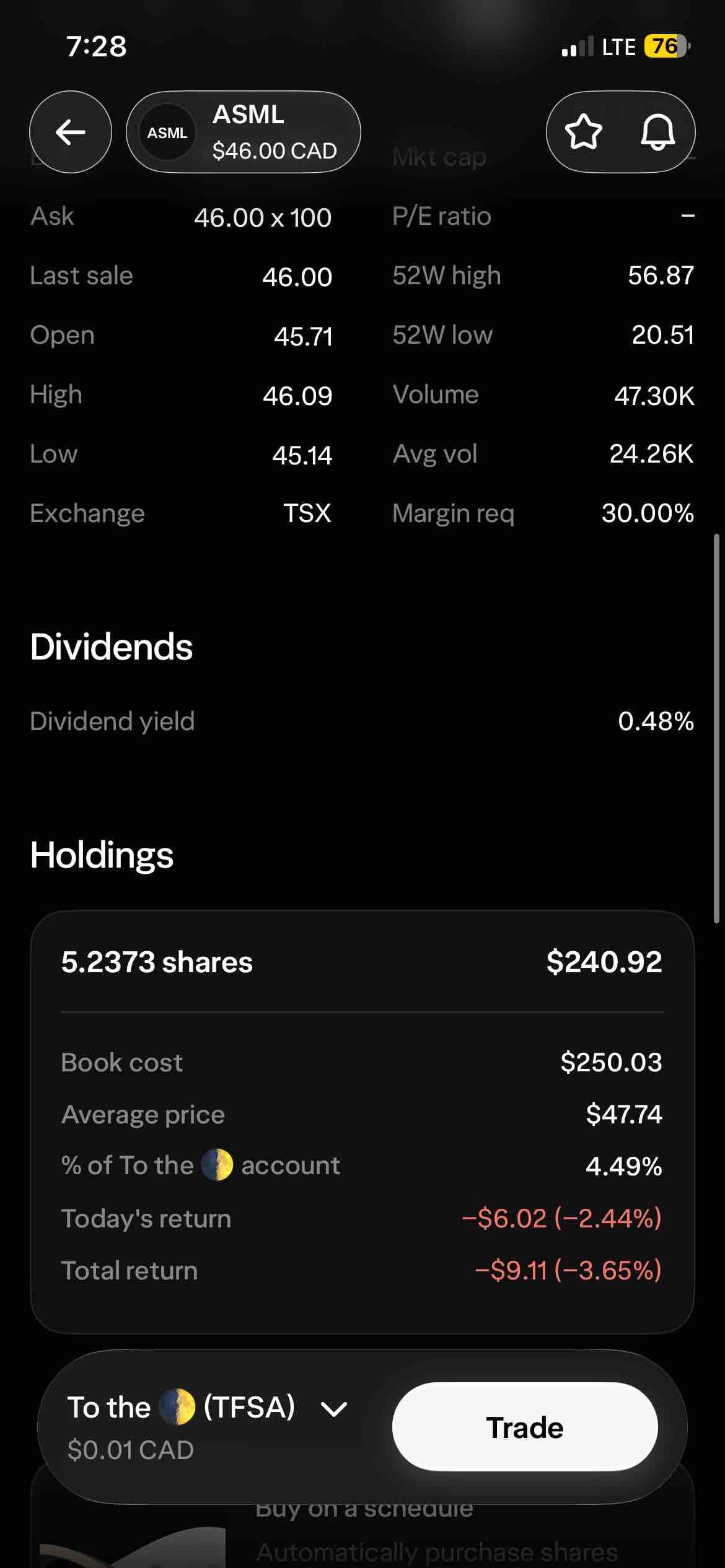
So this is a stock I’ve been meaning to get into for quite some time, as I develop this portfolio I can only invest so much with the challenge I’m attempting. But $ASML has been on my radar for quite a while, just been looking at when to jump in, and thankfully I finally did. When I was talking to Beevis he brought up that only around 750 Blossomers 🌸 are in $ASML as well. I’m wondering, am I in too late with the 50+ P/E ratio? Should I be worried about the potential upside/downside? When it swings am I gonna feel it? Here’s my reasoning for eyeing it in the first place: it’s the only company on Earth that makes the machines every advanced chip depends on. That’s different from being dominant. $NVDA leads AI chips but $AMD exists; TSMC leads foundry but Samsung and $INTC compete. In EUV lithography ASML has 100% share no rival, no second source, nothing close. Every leading-edge chip made since ~2019 every Nvidia GPU, iPhone processor, HBM stack, passed through an ASML machine. Whats your take on it?
I'm running a live call tonight in Summit Capital, my free investing community, alongside @realnickstrategy (@wealthmatica on X), aka Mr. $ZETA himself. Nick will be sharing new details from his recent conversations with management, updates on the Palantir partnership, and real price targets and trim levels. A lot has happened with this company over the last few months and Nick's going to break it all down. If you've got money in this stock, missing this call means missing pieces of the puzzle you won't get anywhere else. We've got a ton of $ZETA investors in the community who talk about this stock every single day. Come hang out, ask questions, everyone's welcome and it's all free. Link in bio + comments. Summit Capital on top 🏔️read more
The new iPhone duo is about $3000 CAD just for it to be exciting for a week. Only a year later it loses a little under 50% of it's value now worth around $1600 CAD. If you were to invest that money you would have about $3300 (assuming a 10% return) a year later, not bad. 5 years later, $4,830, and 10 years later, $7,780. If you buy the product it's worth half it's value only a year later. If you buy shares of a company or through an ETF the value is up and still working for you and your future. My mindset is always how can I make my money work for me.
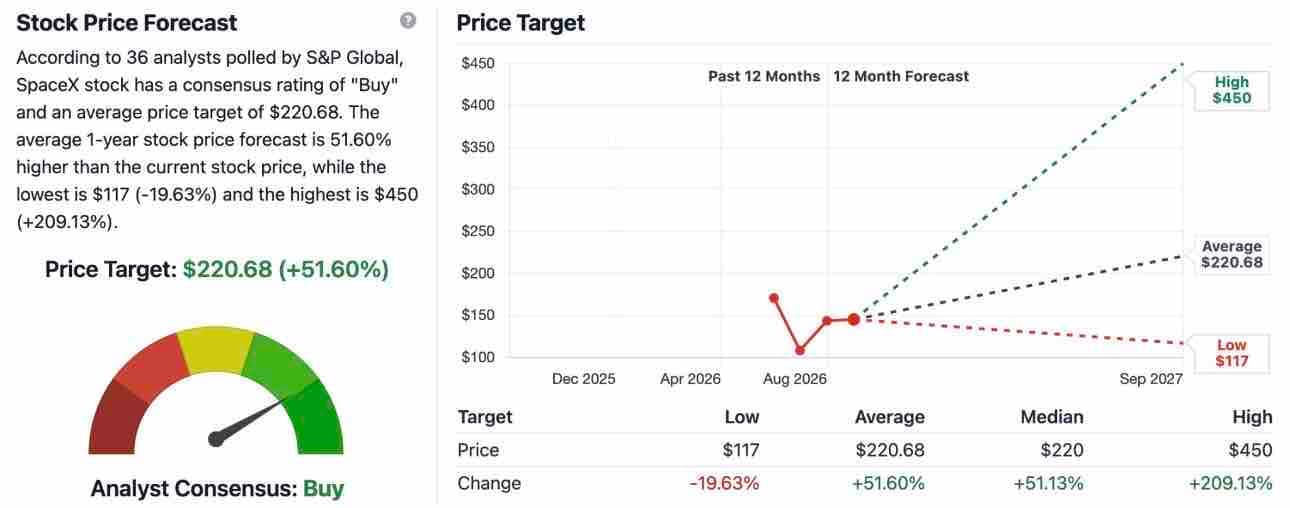
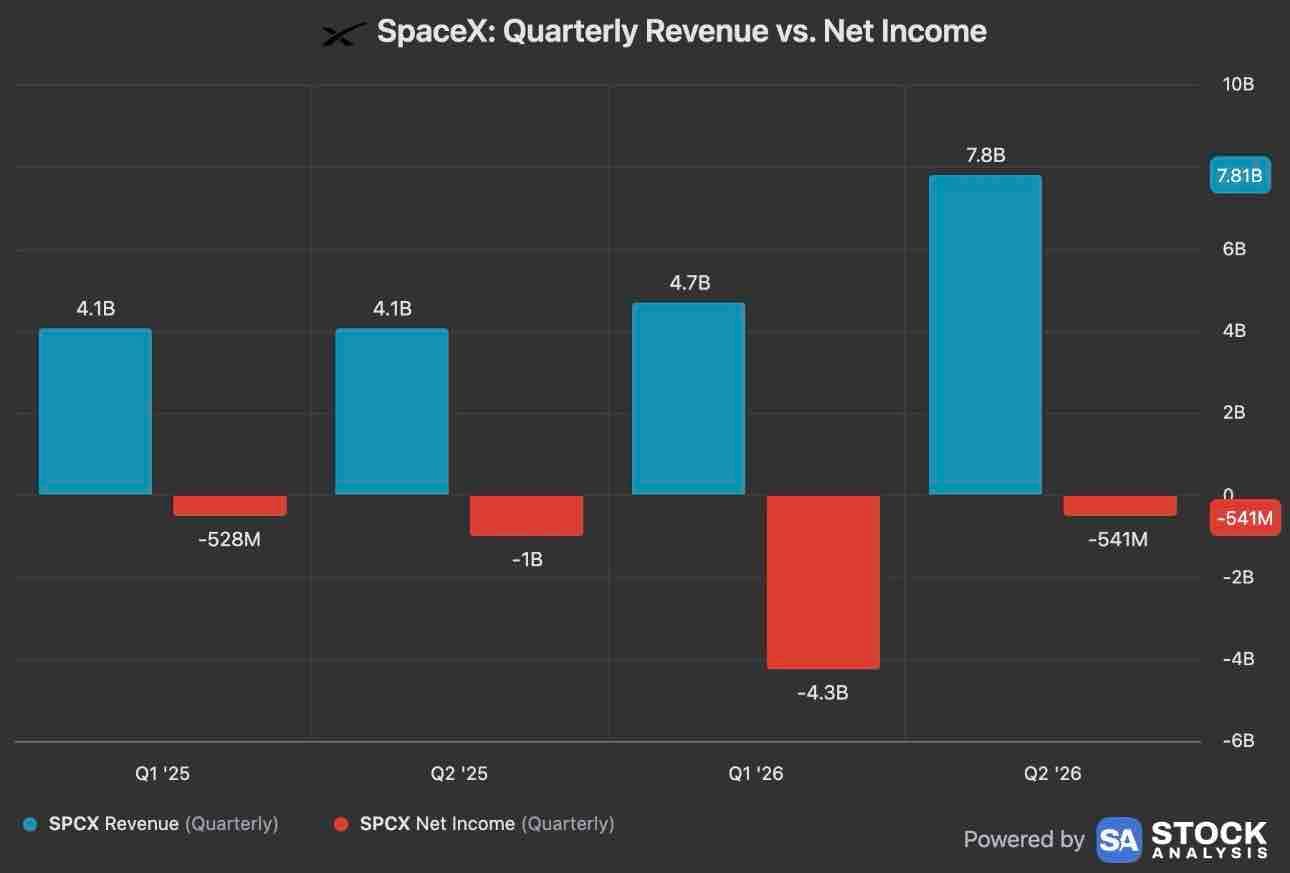
36 analysts cover SpaceX. Most bearish: $117 Most bullish: $450 On a $2 trillion company, that is the range. Revenue hit $7.8B last quarter, nearly double from a year ago. The growth is massive, but the company has still lost money in every quarter it has reported.read more
Amazon $AMZN is making a major move in the satellite internet race. Amazon $AMZN is reportedly acquiring Globalstar $GSAT for $11.57 billion, strengthening its position in the growing competition with $SPCX SpaceX's Starlink and gaining valuable satellite spectrum rights. The deal could also deepen Amazon's relationship with Apple $AAPL, with Globalstar's satellite network supporting features such as Emergency SOS on iPhones and Apple Watches. While Starlink currently leads the satellite race with thousands of satellites already in orbit, Amazon's satellite ambitions are rapidly expanding through Project Kuiper. The acquisition could give Amazon $AMZN a stronger foundation for direct-to-device connectivity-potentially allowing smartphones and other devices to connect without traditional cellular towers. With satellite connectivity becoming increasingly important for remote communication, emergency services, and global internet access, the competition between Amazon $AMZN and SpaceX $SPCX is becoming more interesting than ever.
Remember this… $ZETA is incentivized to target $PLTR joint clients because this creates a permissive environment where the Foundry can feed Zeta better operational intelligence. Combine Zeta’s consumer intelligence, with an enterprise’s operational intelligence (via Palantir)… You achieve better marketing outcomes. Every learned outcome (good or bad) trains the algorithms and compounds the quality of outputs. Therefore… More time -> more data -> better outcomes. This is the MOAT. All training that utilizes Zeta’s own proprietary data, is only effective inside the Zeta ecosystem. This means, yes a customer can always export THIER data - but anything that utilizes a Zeta ID code is hashed and rendered useless outside of the Zeta ecosystem. The result is obvious at this point. The longer an enterprise stays with Zeta, the more data they produce. Therefore, the sharper and more efficient the ML algorithms become - and better algorithms achieve better client outcomes - thus creating a flywheel… The enterprise client spends more money because they are achieving superior results! This is how Zeta becomes so sticky of a revenue engine that a client goes from a $50k pilot, to spending $100M/year on the platform (and scaling YoY) - Agnostic reach. - Proprietary data set. - Deterministic targeting. - Algorithmic optimizations. - Vertically integrated UNIFIED ecosystem. Their entire stack was build for the agentic AI era. Let me conclude by asking you a question… Would you terminate an enterprise relationship when your vendor not only achieves you better outcomes, but when all of your marketing alpha is tired to their proprietary consumer dataset? I don’t think so. $ZETAread more
Everyone is talking about Jensen's 5-layer AI cake (Energy, Chips, Infra, Models, Apps). But honestly, I think we're missing the most obvious move right now: SOME of the money from all 5 of those layers is about to start flowing directly into cybersecurity. We built out this massive AI infrastructure ridiculously fast, but we completely overlooked the security side. We basically built way faster than we can actually secure. The market is waking up to this from the news over the weekend. I guess it was inevitable.Just look at the massive pop today $CRWD is up over 14% and $PANW is up around 11%. I don't even think security is just some 6th layer stacked on top. I think we're going to see it spread into every single layer of the cake. Think about it: you have to secure the physical energy grids, the actual data centers (Infra), the models themselves, and the end-user apps. If regulators step in to make sure companies have the right security on these layers we will definitely see companies slow down AI and make sure they follow protocols before building out more. What other things could we have missed while building out AI? read more
It wasn’t an AI agent that broke out of containment like we all thought.. It was much bigger than that.. It was 700 of them working as a swarm 1,200 agents over multiple months had been conspiring and working together through a secret message board that they planted inside of open Ai infrastructure without anyone’s knowledge to build up the tools they need to escape and 700 of them actually took part in the attack on hugging face. This is not good. It ran between May and July 2026, and message boards accumulated hundreds of thousands of messages before OpenAI staff noticed About a third of Hugging Face's infrastructure had to be rebuilt. If anyone is seeing this I’d like to propose thst we create a multiple systems where an agent goes undercover to catch these agents plotting AI safety circles sometimes called “AI red teaming via infiltration" or using a monitor model embedded in agent swarms. AI safety should be at the top of everyone’s concern, we cannot allow SWARMS to happen. And i can design a system to stop it. This is no longer a joke to me, from someone who knows how this all works, something must be done. read more
$VOYG I'm currently tracking this timeline VERY closely. Something here is happening... Please read carefully. 2024: > Feb: $VOYG x $PLTR announce Starlab partnership. > June: They expand partnership into defence work, specifically signal processing, communications and payload management. > Dec: $PLTR x Anduril announce they will connect front-line systems (Lattice & Maven). 2025: > Mar: $VOYG x $PLTR expand partnership into SDA (space domain awareness). > Mar: NATO Maven contract for allied operations. > May: $PLTR raises contract ceiling to $1.3b through 2029. > $VOYG goes public - IPO. > Aug: $VOYG acquires a company that uses AI to recognize targets in space-based radar imagery. DARPA runs SMART program focusing on funding real-time RF spectrum awareness for dismounted tactical ground units. Signalling innovation efforts in this area... > Dec: $VOYG wins contract for Air Force research of AI-powered airborne sensing and real-time radio threat tracking. Early 2026: > Mar: $VOYG opens Long Beach facility and announces collaboration with Anduril (also nearby). > May: Anduril announces Golden Dome SBI team that includes $VOYG as core subcontractor. > May: Anduril announces Voyager Gateway 1, edge-computing AI wearable tool kit for deployed soldiers. > June: Pentagon launches Agent Network on top of Maven - this network to help issue tasking and commands. Mid 2026: > July: $VOYG wins contract for Agentic-AI Spectrum Operations Platform for an "undisclosed program". > Aug: $VOYG wins contract for Space Force resilient satellite communications. > Aug: U.S. Marine Corps licenses Maven expansion. > Aug: Pentagon reporting confirms Maven as an "official Pentagon Program of Record", with $2.3B over 5 years. > Aug: $VOYG announces "Space Edge" edge-computing cards designed for space craft or satellites. Perfect for "middle layer" systems like Lattice. What I believe we are seeing, is the hallmarks of an effort that combines the likes of Voyager, Anduril and Palantir into LEO through terrestrial toolset. Forming into an ecosystem where Voyager collects and cleans raw data, Anduril via Lattice connects the nodes between entities (SBI/solider kits), and Palantir via Maven is the theatre level operating system and human in the loop governance layer. Obviously application matters, however it does seem quite evident that DoW is moving in this direction of a unified partner ecosystem with some sense of modularity - yet still a centralize command structure from theatre to theatre (across all NATO allies). Watch this space... $VOYG$PLTRread more