A little backstory. The 4% rule was introduced by financial planner Bill Bengen back in 1994. The idea is that you can withdraw 4% of your investment portfolio in your first year of retirement, then increase that dollar amount every year to keep up with inflation. But in 2025, Bengen revisited his research and found that with a more diversified portfolio, the historical starting withdrawal rate could actually be closer to 4.7%. So what does that mean for your FIRE number? Let's say you spend $40K a year. Using the traditional 4% rule, you'd need $1 million invested. Using 4.7%, you'd need approximately $851K. That's almost $150K less. Which is a pretty big difference! BUT before you start lowering your retirement goals, there's something important to consider. This research looks at historical US market data over a 30 year retirement. If you're planning to retire in your 30s or 40s, your money could need to last 40, 50 or even 60 years. And yes, inflation is still accounted for. You're just starting with a higher withdrawal amount and increasing that dollar amount with inflation each year. Personally, I think this is a really interesting reminder that the 4% rule isn't necessarily a one size fits all approach. So I'm curious, would you feel comfortable using 4.7% to calculate your FIRE number, or are you sticking with the traditional 4%?read more
Had to sell my RRSP in order to use the Home Buyers Plan! Felt so wrong selling so much lol. But luckily I made some nice gains to help with the house 😅
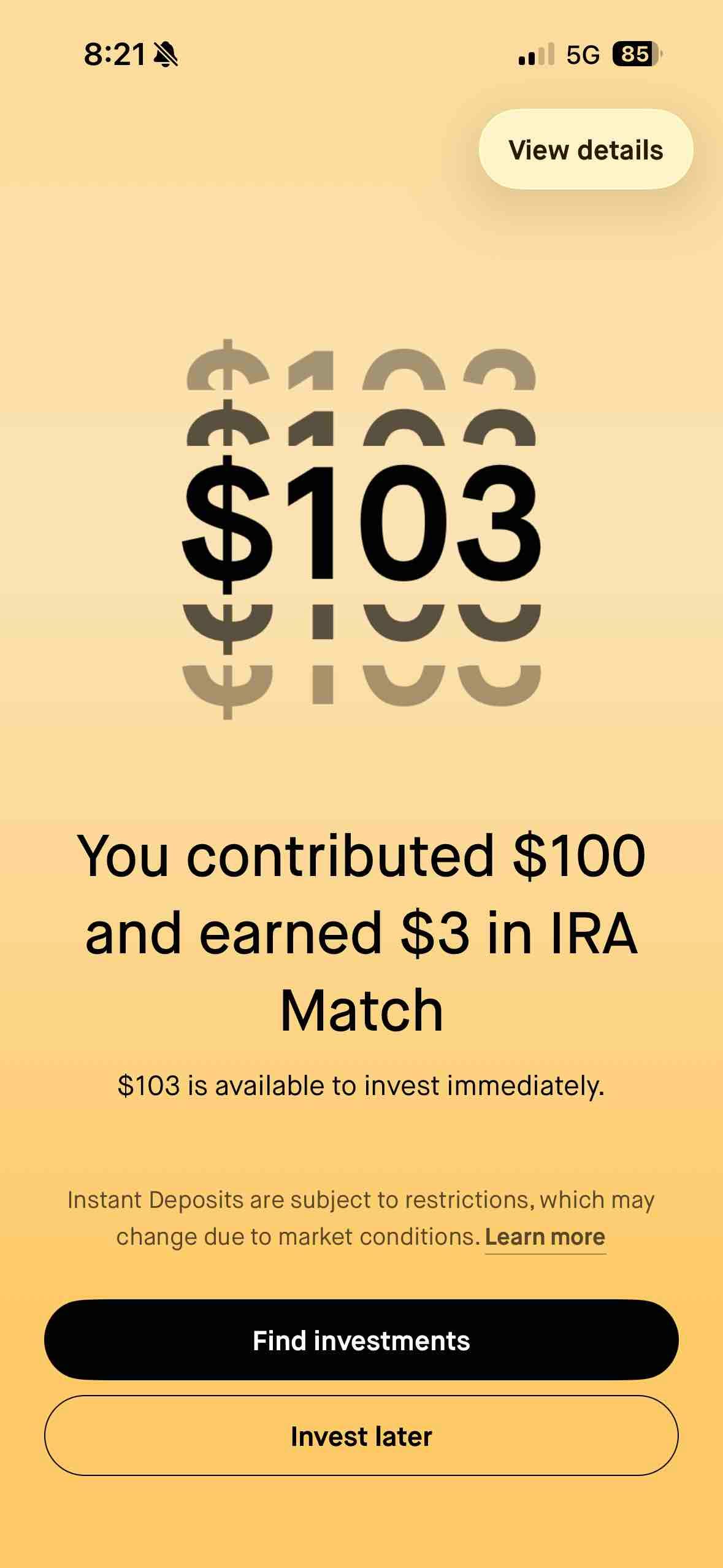
Putting another $190 to work this week! Roth IRA – $100 deposited ($103 with the extra $3 Robinhood Gold match!) * $53 – $VOO * $50 – $SPCX Brokerage – $90 deposited * $50 – $SOFI * $20 – $AMZN * $20 – $BE Another payday, another opportunity to stack assets and keep building. Small deposits add up over time. Enjoying vacation in Tennessee ☀️☀️☀️read more
My portfolio rule for this chapter of life: if it needs daily attention, it's too complicated. Real estate was about 70% of our net worth; the target is 50%, with sale proceeds going into financial assets — not recycled into more property. The whole series is on my profile — tap my name.
This month I folded my Canadian dividend ETFs into one broad-market index ETF. Fewer lines, same exposure, much less to babysit. At some point “diversified” had quietly become “duplicated” — three funds holding the same big banks isn’t diversification, it’s clutter.
Great listen - maybe Canada can take inspiration and create a similar initiative for our children. Imagine starting so early in compounding a small lump sum investment- you would not need to worry about having enough for retirement with the power of 50+ years of compounding. It would probably be very appealing for Canada’s ultra rich to donate to this type of cause - win win all around. https://podcasts.apple.com/ca/podcast/invest-like-the-best-with-patrick-oshaughnessy/id1154105909?i=1000802478718
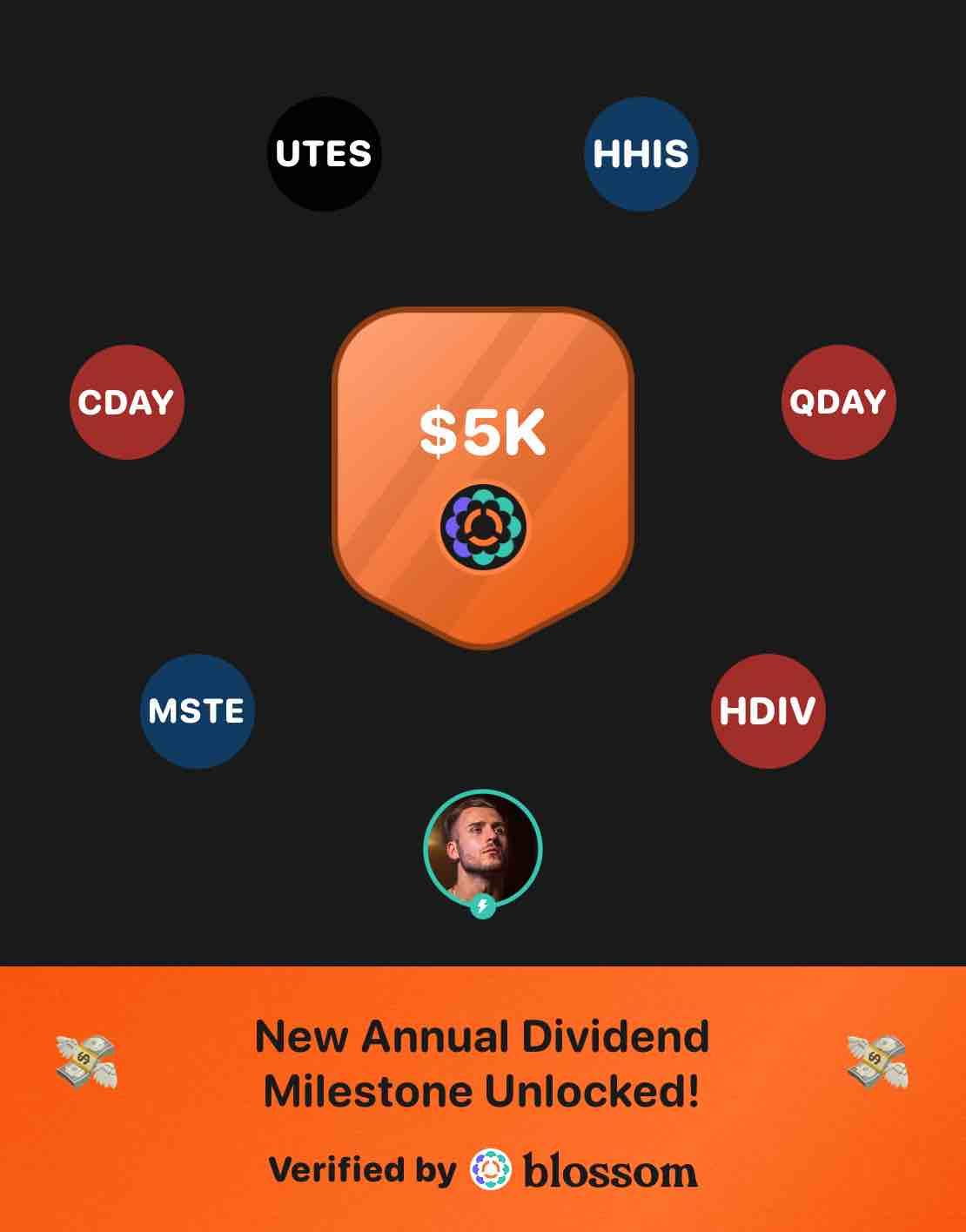
Here's a milestone I've been working towards for a while! It makes me so happy to achieve it. Staying consistent is the key! (As Always) Can't wait to see what the future holds. Thank you guys! 🎉
Maya and I put my 9–5 salary on one side of a whiteboard and the income we’re building on the other. I want to be able to quit by 30. At the six-month check-in, the rental went from $325/month to $250. YouTube went from $0 to $621/month. It’d be easy to make the update look better by only showing the second number lol. If you’re trying to make work optional, what’s the first bill you’d want your investments to cover?
I was able to invest quite a bit. At least for me during this crash. Around $2000. That got my across the $5k dividend mark. My portfolio currently is: $MSTE$BDAY$HHIS$HDIV$CDAY$QDAY$UTES$SDAY
This gets my monthly distribution goal a bit further away so I’m sad. But I understand completely, distribution is a % of price so yeah when price goes lower distribution goes lower. If you want to keep the same monthly distribution reinvest those distribution and get your ACB lower. Keep an eye on your total returns also, it matters! My first purchase was 5.75$ (if memory serves right) and I was green on book cost and total returns on MSTE before this down. I did buy more. Do not use money you need to eat to invest. Start small enough that you don’t panic when it’s fluctuating. It’s not magic and money will come in time.
Here are the latest distributions compared to last month! $SPYI: $0.5160 🟢 (was $0.5087) $QQQI: $0.5838 🔴 (was $0.6343) $IWMI: $0.5719 🔴 (was $0.5728) $NIHI: $0.4255 🔴 (was $0.4300) $BTCI: $0.5481 🔴 (was $0.6954) $IYRI: $0.4260 🟢 (was $0.4113) $IAUI: $0.4475 🔴 (was $0.4827) $MLPI: $0.5916 🔴 (was $0.6022) Two increases and six decreases this month. Remember, these distributions will fluctuate month to month. That’s part of investing in income-focused funds. Another Friday, another payday. Let that cash flow keep working!read more
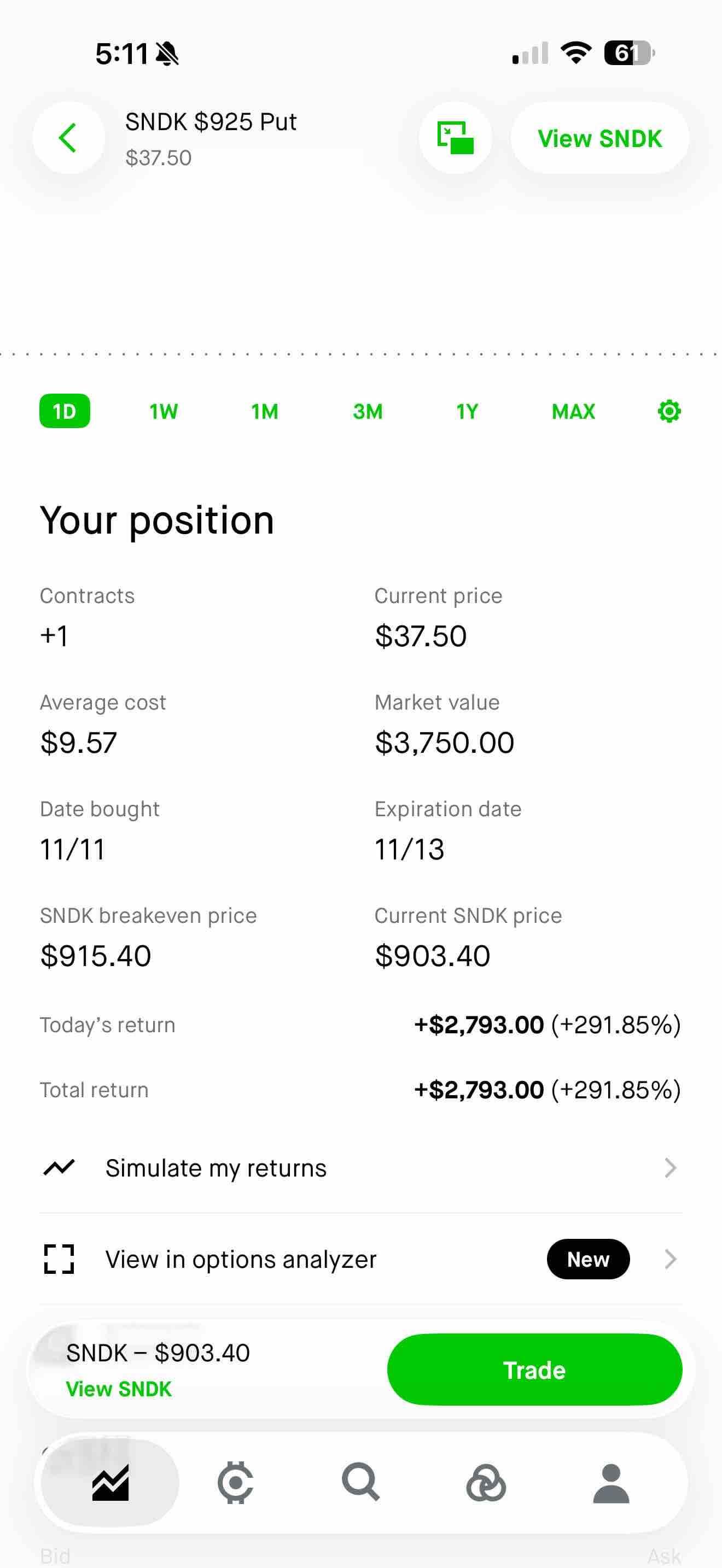
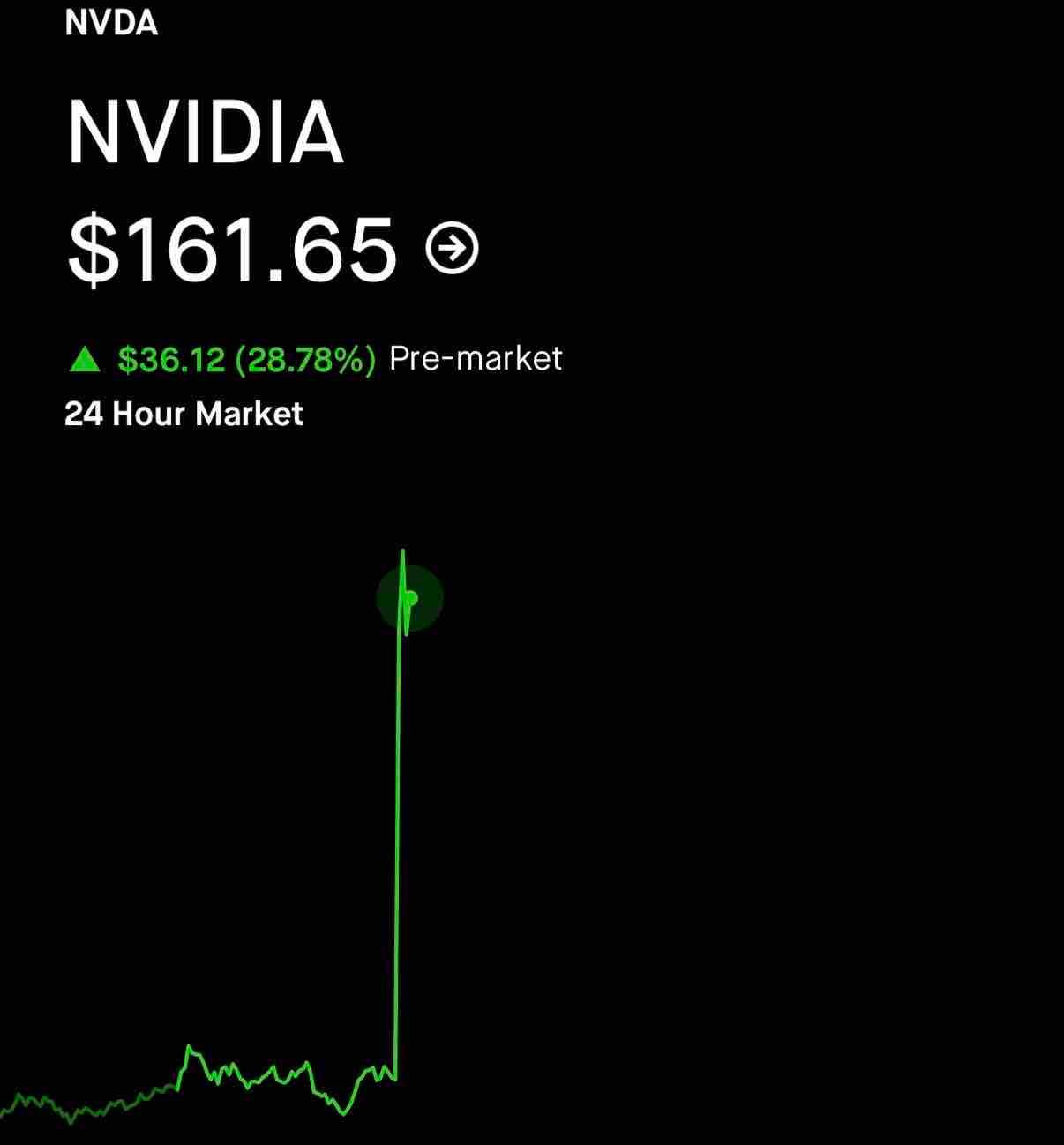
Right before Close last Friday someone bought $3,400,000 worth of $NVDA 160 calls which expire today. This morning Jensen Huang was reinstated as Nvidia CEO. After a rough (9,000%) gain these contracts will be worth beyond $312,000,000. Clear levels of insider trading is happening…
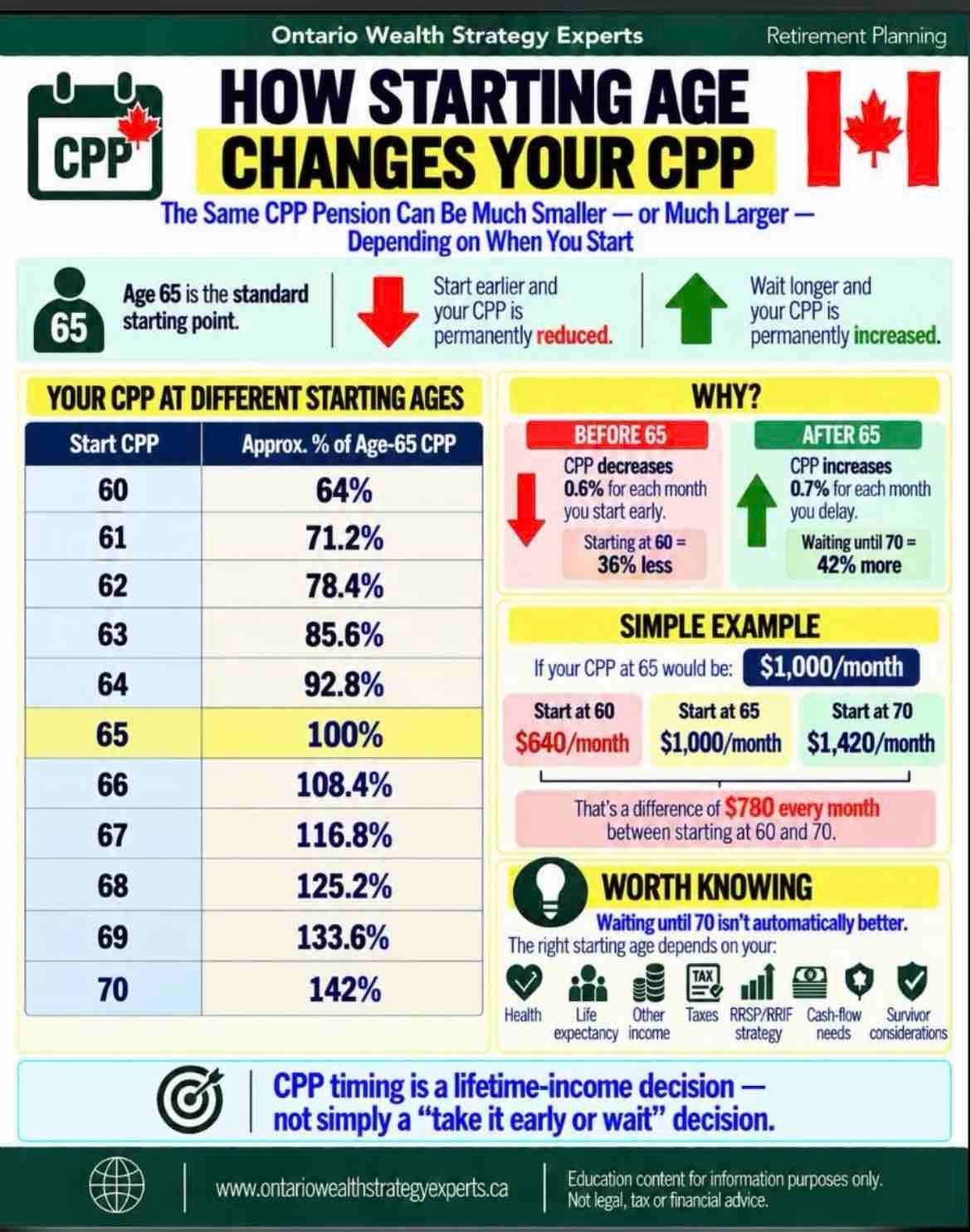
— When you start taking your Canada Pension Plan (CPP) can make a huge difference to your monthly retirement paycheque for the rest of your life. Age 65 is the standard starting point (100% of your pension). If your CPP at 65 is $1,000/month, starting early at age 60 drops it permanently to $640/month. Waiting until age 70 bumps it up to $1,420/month, a $780/month difference for life! Good to know: 1. The penalty and bonus are not equal: Starting early cuts your CPP by 0.6% per month (36% less at age 60), while waiting past 65 boosts it by 0.7% per month (42% more at age 70), plus the higher payout grows with inflation every year. 2. Waiting until 70 is not automatically best for everyone: Your health, family life expectancy, tax bracket, and whether you plan to draw down your RRSP early all play a big role in picking the smartest start date. 3. Many Canadians bridge the gap from age 60 to 70 by drawing down their RRSPs early and letting their investments keep compounding in broad, low-cost ETFs like $XEQT, $XGRO, or $VBAL, or dividend funds like $VDY, $XDIV, and $XEI. At what age are you planning to start your CPP, 60, 65, or 70? — This is for informational and educational purposes only. read more
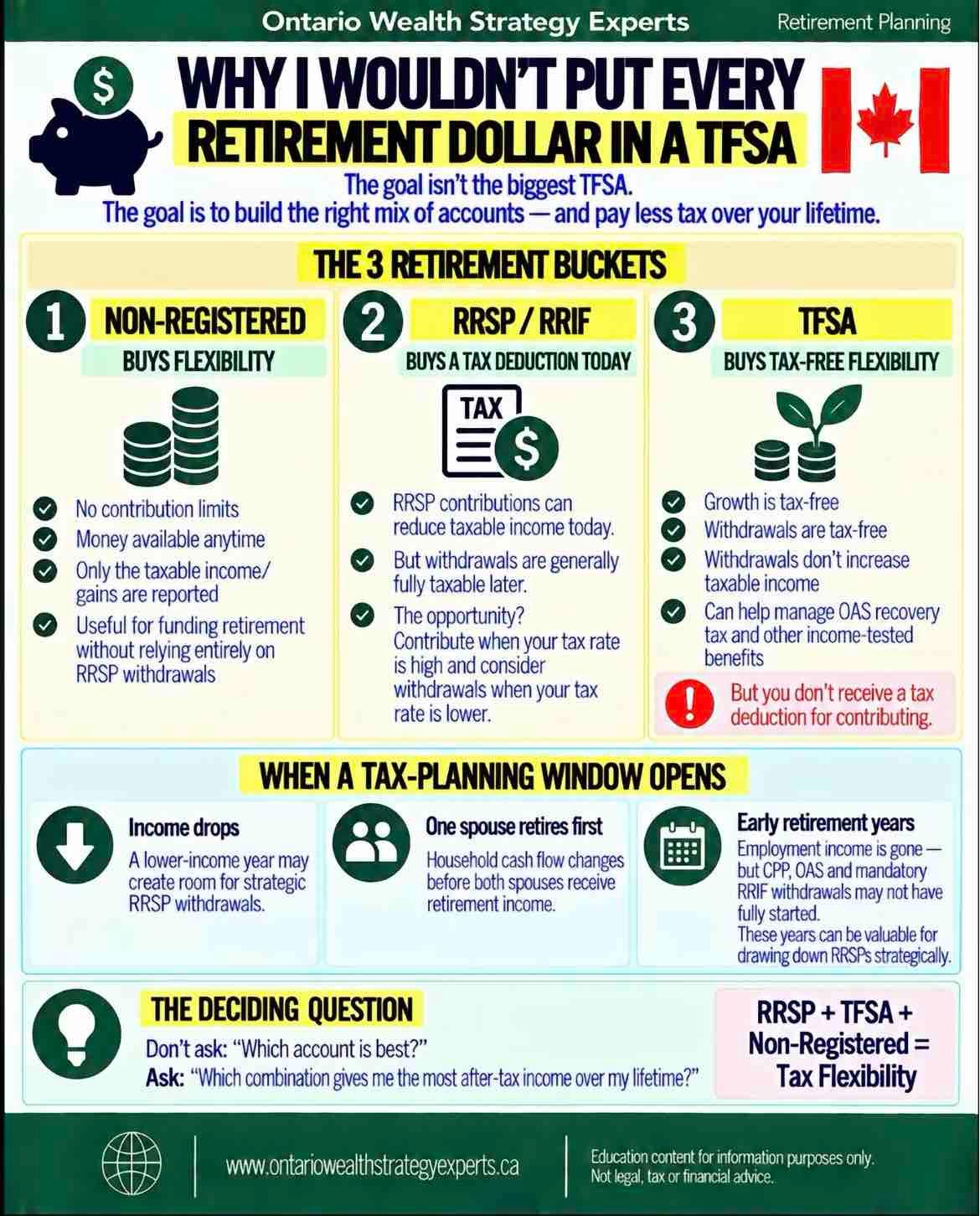
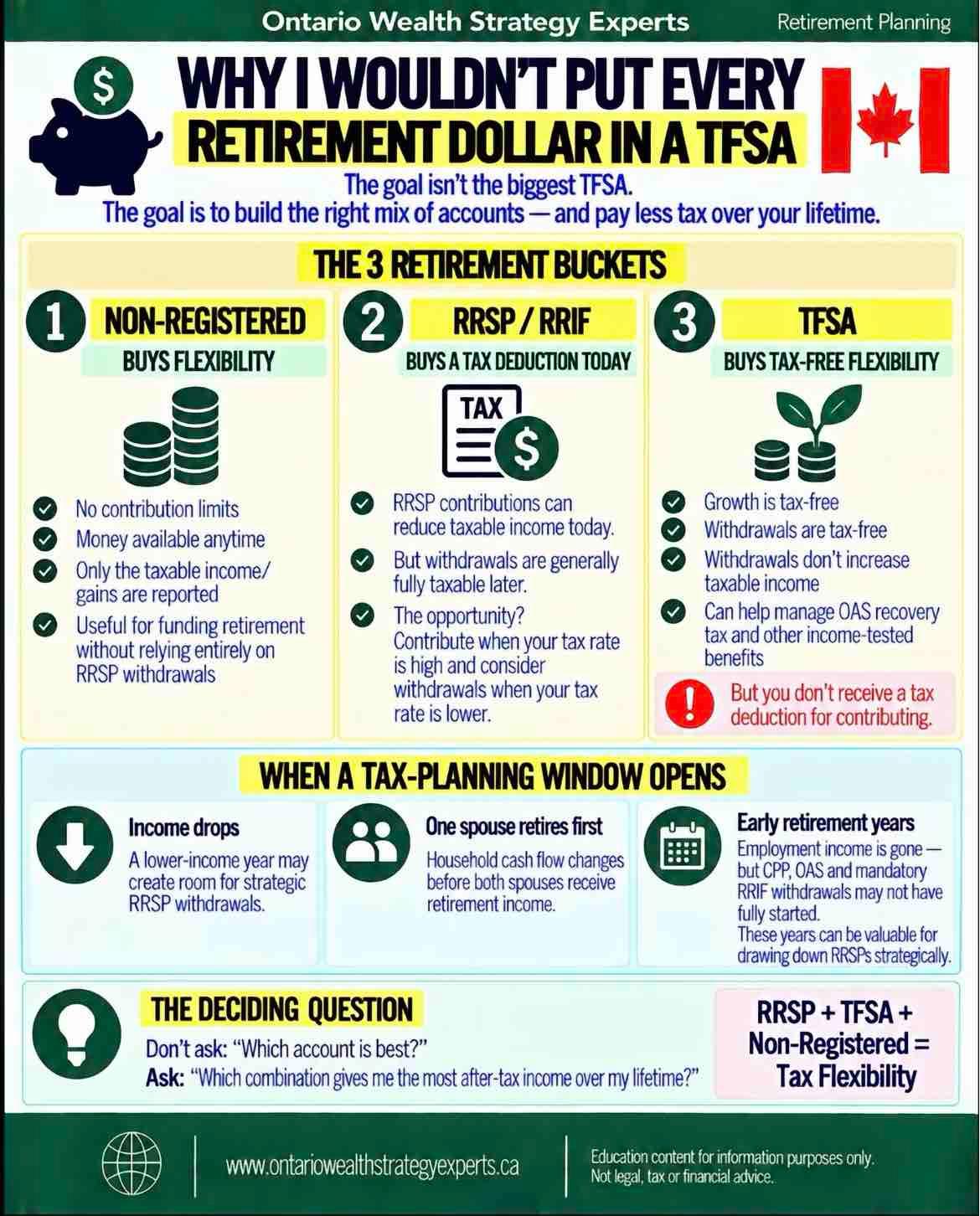
— Part 2: (please see part 1 first, previous post) — Spending the 3 Buckets In the last post, we looked at why building all 3 retirement buckets (TFSA, RRSP, and Non-Registered) beats relying on a TFSA alone. (Please see the attached image) Knowing which account to spend first when you retire so you pay less tax and keep 100% of your OAS. Here is the age-by-age drawdown game plan: 1. Ages 55–64 (The "RRSP Meltdown" Window) - Draw from: RRSP + Non-Registered first; leave your TFSA untouched. - Why: With no paycheque and no CPP/OAS yet, your tax bracket is super low. Tapping your RRSP early lets you pay ~15%–20% tax instead of 40%+ later, and shrinks your balance before mandatory RRIF rules hit. (Great time to trim balanced or income funds like $ZBAL or $VRIF in your RRSP). 2. Ages 65–70 (The OAS Protection Window) - Draw from: RRSP/RRIF + Non-Registered up to just below the OAS clawback line (~$95,323 in 2026), then top up with your TFSA. - Why: Need $15,000 for a trip or a new roof? Pulling it from your TFSA adds $0 to your taxable income, keeping your OAS completely safe. 3. Age 71+ (Mandatory RRIF Years) - Draw from: Mandatory RRIF minimum first, supplemented by TFSA and Non-Registered. - Why: Because you already trimmed your RRSP in your 60s, your forced annual withdrawals stay manageable and your tax bill stays low. Good to know: 1. If you convert your RRSP to a RRIF at age 65 (even just partially), your withdrawals qualify for the $2,000 Pension Income Amount tax credit, and you can split up to 50% of that RRIF income with your spouse to cut your tax bill even further! 2. Delaying your OAS from age 65 to 70 permanently boosts your monthly payments by 36% (0.6% per month), which makes bridging ages 65–70 with your RRSP and Non-Registered accounts (like $VDY or $XEI) an even stronger move. Which account do you plan on tapping first when you retire? — This is for informational and educational purposes only. read more
— Part 1: — We all love the TFSA, tax-free growth and zero impact on OAS clawbacks are hard to beat. If you can max it out, you definitely should! The catch? You can't actually put every retirement dollar into a TFSA, and trying to rely on it alone means leaving serious tax savings on the table. Here is why smart investors build all 3 retirement buckets instead of just one (please see the attached image): 1. TFSA (Tax-Free Flexibility & OAS Shield) Your lifetime TFSA limit is capped ($109,000 total as of 2026). That's great, but usually not enough to fund a 30-year retirement by itself. Use it for high-growth equity ETFs like $XEQT, $VEQT, or $VFV so your biggest gains stay 100% tax-free, and pull from it in retirement without triggering OAS clawbacks. 2. RRSP / RRIF (The Tax-Bracket Win) If you earn a high income today (paying ~40%+ tax), contributing to an RRSP gets you a huge tax refund right now. When you withdraw that money in retirement in a ~20% tax bracket, you pocket the difference. It's also the best home for US-listed ETFs like $SCHD, $VOO, or $QQQM since they skip the 15% US dividend withholding tax here. 3. Non-Registered (No Limits & Cheap Taxes) Once your TFSA and RRSP are full, this bucket has zero contribution caps. You only pay tax when you sell for a capital gain (at half your normal tax rate), and Canadian dividend funds like $VDY, $XEI, or $ZEB get the generous Canadian dividend tax credit. Good to know: 1. Early retirement (ages 60–65) is a massive tax sweet spot. Once your paycheque stops, but before CPP, OAS, and mandatory RRIF minimums start, you can draw down your RRSP at a super low tax rate. 2. At age 71, the government forces you to convert your RRSP into a RRIF and withdraw a minimum percentage every year, starting at 5.28% and climbing past 8.5% by age 80. If your RRSP gets too big, those forced withdrawals alone can push your income over the 2026 OAS clawback threshold ($95,323), costing you 15 cents of OAS for every dollar above it! Coming up in Part 2: Which account should you actually tap first when you retire, and at what age? Are you team "TFSA first" or "RRSP for the tax refund" right now? — This is for informational and educational purposes only. read more