$MU$SNDK$AMD$NVDA$TSM These names are down -4 to -6% today once again as the retail leverage continues to unwind. Meanwhile, I believe the market is pricing in the worst case scenario of CAPEX spend decreasing year over year which is far from the reality of the hyperscaler announced plans. I will stick to the fundamentals here, and I like them a lot. https://youtu.be/YacIFOiogf0?si=qzS_RzAteIQxqqjT
As I’m now trying to keep a lean portfolio and holdings, I’m thinking of selling off my holdings in $TD and $RY for the ETF that tracks top 6 Canadian Banks $RBNK What would you do and why? Btw I’m already in profit in both stocks. My $RY returns is already at 103%+
@canadianinvestor The Dot-Com Bubble (2000–2002): When Excitement Outran Reality The dot-com crash remains one of history’s greatest investment lessons. It demonstrated that even revolutionary technology can become a poor investment when investors pay unrealistic prices. The internet truly was changing the world, but during the late 1990s many investors forgot one important rule: A great company is not always a great investment at any price. ⸻ The Rise of the Internet During the mid-to-late 1990s, the commercial internet exploded. Investors believed nearly every company ending in “.com” would become the next global giant. Many technology companies: * had little or no revenue; * had no profits; * had unproven business models; * were valued based on website traffic or future expectations rather than earnings. Traditional valuation metrics were dismissed as “old economy thinking.” Initial Public Offerings (IPOs) routinely doubled or tripled on their first day of trading. Investors feared missing out more than they feared losing money. ⸻ Maximum Drawdown The technology-heavy NASDAQ Composite reached its peak on March 10, 2000. It then fell approximately 78%, one of the largest declines ever experienced by a major U.S. stock index. The broader S&P 500 declined approximately 49%. Timeline * Peak: March 10, 2000 * Bottom: October 9, 2002 * Peak to trough: approximately 31 months * NASDAQ recovery to previous high: May 2015 (about 15 years) * S&P 500 recovery: May 2007 (about 7 years) The NASDAQ’s recovery illustrates an important lesson: even when the economy recovers, sectors that become wildly overvalued can take much longer to regain previous highs. ⸻ What Caused the Crash? Several forces combined to inflate—and ultimately burst—the bubble. 1. Speculation Investors purchased companies simply because they were internet-related, believing prices could only continue rising. 2. Unrealistic Valuations Many firms were valued in the billions despite having little revenue and no profits. 3. Easy Capital Venture capital and public markets poured money into almost any technology startup, allowing weak businesses to survive longer than fundamentals justified. 4. Rising Interest Rates The Federal Reserve raised interest rates several times in 1999 and 2000. Higher rates reduced the present value of future earnings and made speculative growth stocks less attractive. 5. Reality Arrived As companies failed to generate profits, investors began questioning whether future expectations were achievable. Confidence evaporated, and valuations collapsed. ⸻ Why Did the Market Recover? The internet itself was never the problem. The problem was paying too much for companies that could not deliver the profits investors expected. As weaker companies disappeared: * capital shifted to stronger businesses; * surviving companies became profitable; * productivity increased; * corporate earnings improved; * investor confidence gradually returned. Many household names—including Amazon, Microsoft, and Apple—survived the crash and eventually became some of the world’s most valuable companies. The technology revolution was real; the bubble was the price investors were willing to pay for it. ⸻ Lessons for Investors The dot-com crash teaches several timeless lessons: * Revolutionary technology does not eliminate the need for reasonable valuations. * Markets can remain irrational longer than investors expect, but fundamentals eventually matter. * Diversification protects investors when one sector becomes excessively popular. * Chasing recent winners often leads to buying near market peaks. * Even after devastating crashes, innovation continues and markets eventually recover. Perhaps the most important lesson is this: The future can be bright while an investment is still overpriced. Successful investing is not only about identifying tomorrow’s winning industries—it is also about paying a sensible price and having the patience to hold through periods of extreme volatility. The dot-com crash reminds us that excitement creates bubbles, fundamentals eventually prevail, and disciplined investors who remain diversified are better positioned to benefit when optimism returns to reality. read more
This is interesting. I was just about to rotate a decent amount of money into $ZBAL or $XBAL in anticipation of the Japanese Carry Trade unwinding over the next few months but bonds will be a huge mistake. Key Take Aways: 1. The Nasdaq will get hit exceptionally hard; as Japanese’s money is heavily invested in tech. 2. Bonds will get hit hard as the bond market will undergo turmoil as Japanese Dollars pull out American Bonds and the USA Stock Market; 3. The USA dollar will get hit hard; however, big American multinational companies that trade in multiple currencies will see an increase in profits benefiting from a weaker USD; 4. Leveraged traders will get wiped out; Felix says to get rid of all margin; 5. Money will flee, looking for protection in: I. Gold; II. Non-Tech stocks (think $SCHD) and III. International Stocks. 6. This will not happen all at once, it will happen gradually over the next few months until the bomb goes off all at once. 7. The Japanese government has spent 75 Billion Dollars trying to prevent this to no avail. 8. It is not just Japanese business and retail involved in the Japanese Carry Trade but international businesses and Hedge Funds. So this will be a magnified explosion. 9. Now is a time to hold a decent amount of cash ready to deploy in a 25-35% market crash - while I was going to deploy to $ZBAL, I will continue my $750 weekly buys but start setting aside another $5000 a month into dry powder. When others are crying, I’ll be buying. https://youtu.be/y-xEgwD_EE4?si=PwFVE7q_51ELzJ7I read more
$GOOGLis a $450 stock trading at $346 $TSM is a $560 stock trading at $400 $MU is a $1,255 stock trading at $855 (was literally there this year) $RKLBis a $150 stock trading at $67 $NBISis a $300 stock trading at $167 (was there in June) $CELH is a $55 stock trading at $29 $CRDO is a $280 stock trading at $201 Funny how everyone loved $MU at $1,255 and $NBIS at $299… but nobody wants them 30-45% off 🤔 Same companies. Same story. Different price tag. Buy the fear, not the hype read more
Sofi is currently down 10% after meeting analysts expectations but missing on its technology platform. The technology platform made $242 million out of $3.6 billion in 2025, only 6.7% of total revenue came from this segment. Post 2025, Sofi lost a large enterprise client leading to a drop in this segments revenue. Now Sofi is being punished. The question is whether we let one segment impact the stock so heavily after seeing generous growth from its main business? Is it a buy? Maybe Is the market overreacting? Most likely Is this still a great growth stock? Enter in comments how you feel. read more
Liberals and Sanders supporters have always said they want a Scandinavian model of government. It’s time the poor pay their fair share. Meanwhile Billonaires like Jeff Bezos believe the poor should pay 0 taxes. Pure evil. $AMZN$SHOP$SPY$QQQ
- Mastercard Q2 2026 was strong: net revenue rose 14% to $9.3B and adjusted EPS came in at $5.04. - Core volume trends were healthy, with gross dollar volume up 8%, purchase volume up 10%, and cross-border volume up 12% on a local-currency basis. - Operating leverage held up well, with operating margin expanding to 60.2% and adjusted operating margin reaching 61.1%. - Shareholder returns stayed aggressive: Mastercard repurchased 9.8M shares for $4.9B and paid $771M in dividends during the quarter. https://s25.q4cdn.com/479285134/files/doc_financials/2026/q2/2Q26-Mastercard-Earnings-Release.pdf
I wanted to reach out to the community, specially those that have been investing in individual stocks for a prolonged period of time. I have a concern about DIS and what management is doing and want to know if investors have experienced this before with other large companies and what was the outcome of that investment. I've been a $DIS investor since 2023. It has had it's ups and downs. During this time it has peaked to $120 at least 4 times. The stock is very volatile. But that is not my risk concerns I had with the company. In no specific order, I am also NOT concerned about the following (which seems to be the popular bear cases): 1. Wokeness. 2. Its debt and its ability to service it. 3. Geopolitical risks. 4. Profitability. 5. Growth prospects. 6. Corporate governance. 7. It's ability to attract and retain customers. 8. COVID 2,3,4 or 5.0 What I'm concerned about right now is how management is using its cash that is flowing in. What they been doing for the past few years is using the cash coming in for capex, investing in growth, paying off debt and repurchasing of stock all at the same time. Therefore leaving absolutely no buffer, no margin of error. I'm unclear if I should define it as using the cash efficiently or being so confident in the business that management feels there doesn't need to be a buffer. I also have taken into account $DIS has long relationship with banks and debt investors, therefore they get good rates on the debt compared to their peers. All this would've been fine if management/insiders were buying Disney but they aren't, even though the past 6 months they've purchased more shares than sold. Would like to hear what other practitioners experience is with past investments that has this kind of allocation characteristics. Appreciate your precious time 🙏 read more
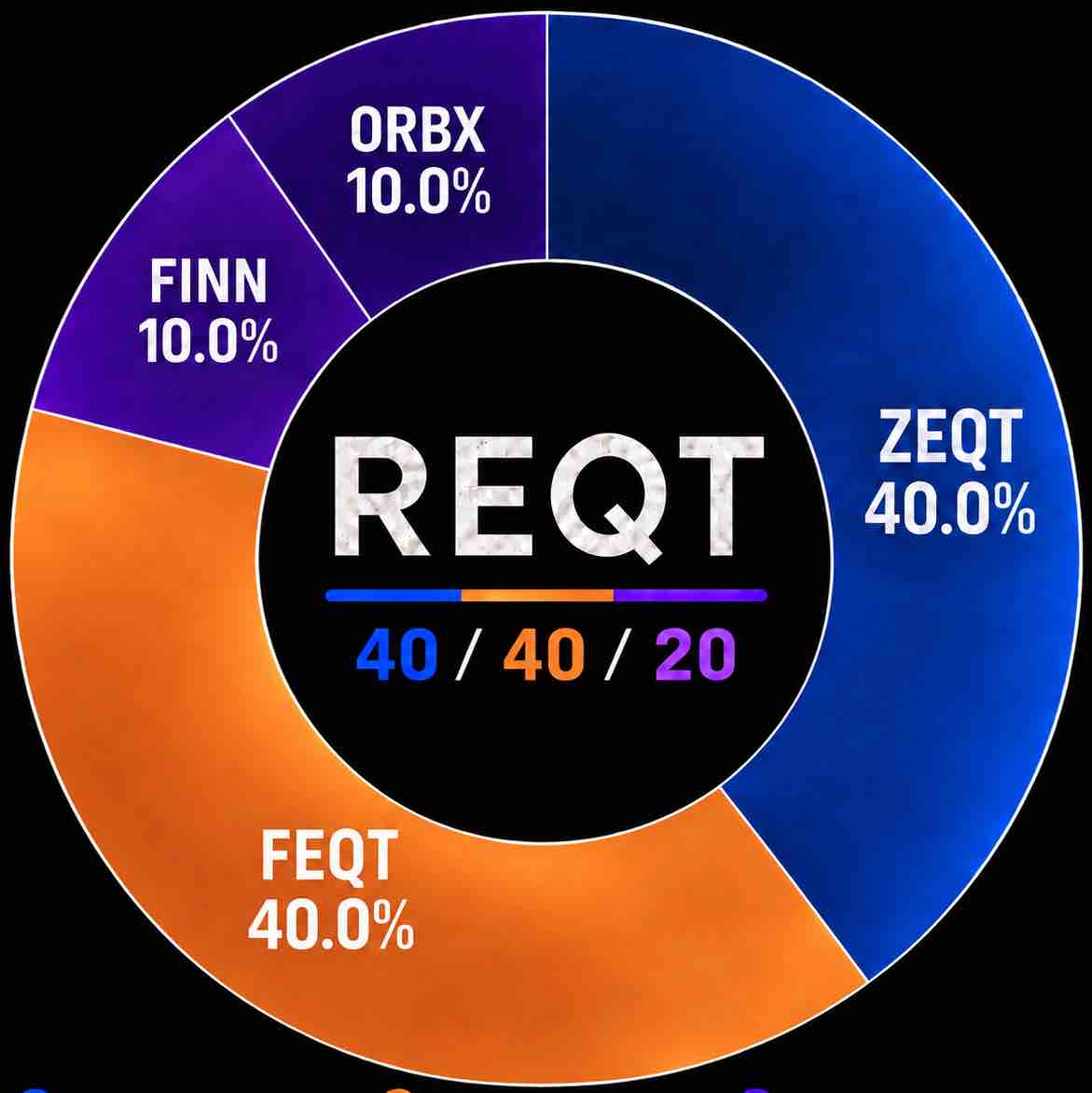
For those who don’t know, @mytranslator (my dad) has spent the past few months building his own factor-enhanced all-in-one portfolio: REQT (Régis’s All-in-One ETF). While REQT isn’t investable (yet), we’ve spent the last few days building something we’re really excited about: 🔗 https://reqt.ca/ The website isn’t just a static portfolio page. It tracks REQT live throughout the trading day as the underlying ETFs move, letting you see its value update in real time. You can also drill all the way down from the ETF allocation to the 3,463 individual companies held underneath. REQT at a glance: • 15 low-cost ETFs across four sleeves: 🇺🇸 US (40%), 🌍 International (25%), 🇨🇦 Canada (20%), 🚀 Global Innovation (15%) • A 50/50 philosophy: half broad-market indexing, half deliberate value and momentum tilts, with targeted exposure to innovation, infrastructure, and space technology • Weighted MER: 0.35% • 3,463 underlying holdings Based on the actual closing prices of the underlying ETFs, the model has returned: 📈 +15.8% YTD 📈 +29.8% over the past year 📈 +25.1% annualized since January 2024 Every number on the website is calculated from real market data, refreshed daily, with weekly rebalancing. Important: REQT is an educational model portfolio, not a fund or investable product. The performance shown is hypothetical, gross of fees, and is provided for educational purposes only. Nothing on the website is investment advice or a recommendation to buy or sell securities. We are not affiliated with any ETF provider, and “REQT” is simply the name of this model portfolio, not a tradable ticker symbol. We would love to hear what you think! Website: https://reqt.caread more
SpaceX raised a historic $85 billion in its IPO when it went public in June. $SPCX reported $24.7 billion in cash and cash equivalents at year-end 2025, which fell to $15.9 billion at the end of Q1 2026 in its initial S-1 filing. That figure later surged to $100.8 billion following IPO and notes offering in June. $SPCX is also now receiving a couple billion dollars per month from Anthropic and $GOOGL through 2029 to lease its AI compute capabilities. With the first share lockup expiration coming next week, selling pressure is expected to be quite significant… But what about the case $SPCX actually reports surprisingly great earnings? The connectivity business through Starlink is highly profitable, and with $100.8 billion in cash now, SpaceX has more cash than enough to cover CapEx costs to continue to expand their AI infrastructure. I wouldn’t rule out a profitable quarter, but I’m still not buying at this valuation. My personal entry price is at $55. read more
Unpopular opinion, or maybe not, but I currently see more valuation upside in $LUNR than $RKLB, despite $RKLB recently acquiring $IRDM. Intuitive Machines has at least 10 major "space systems" catalysts coming up by the end of the year. Meanwhile, I’m expecting $RKLB to delay Neutron into early next year, and the $IRDM acquisition won’t close until mid-2027. Short term the few other catalysts for $RKLB is a satellite bus contract ($VSAT x Space42) + potentially a ~$700 million contract for the Mars Telecommunication Network spacecraft. Large contracts potentially, but not as many opportunities as $LUNR. 👀 Demand for space systems keeps growing, so I don’t think $RKLB revenue will stagnate, they just have to continue to delivery. I remain super bullish overall (especially since their announcement last week to acquire Iridium!!) Since acquiring Lanteris, $LUNR is no longer just a lunar infrastructure company. It now has broader space systems (and national security) exposure, so I now consider them as a semi-direct competitor to $RKLB. As requested by many Blossomers, here are a few upcoming awards for $LUNR and why they matter. 1. MDA (Missile Defense Agency, not $MDA) $LUNR submitted an updated proposal for the first 18 of 45 satellites through Lanteris x $LHX. The decision was expected in June, so I assume this is imminent. Based on previous and similar contracts from other space companies, this could potentially be a $500 million contract. 2. CLPS 1.0 (Commercial Lunar Payload Services) Seven more missions are expected to be announced by the end of the year. IM-5 was awarded in March, and during NASA’s Moon Base update last week, a sixth mission was awarded. 3. Undisclosed order for 2 satellites Management said they already have authority to proceed on two satellites for an undisclosed customer. They expect the contract to convert into backlog once it is signed. 4. CLPS 2.0 This is the second phase of lunar deliveries for heavier cargo landers beyond 2028. NASA has already awarded IM-5 for 2030, which uses $LUNR heavier cargo lander, Nova-D. Bigger contracts and opportunities are expected. 5. Project NEXUS Phase 1 This is a commercial Ka-band relay concept opportunity as NASA transitions away from TDRSS, the Tracking and Data Relay Satellite System. Multiple Phase 1 awards are expected later this year, followed by a down-select, similar to the Lunar Terrain Vehicle contracts. 6. U.S. Space Force Andromeda SG-XX Expected later this year, this is part of an indefinite-delivery/indefinite-quantity contract for next-generation GEO space-domain awareness satellites. 7. CP-32 CLPS A potential delivery task order for an instrument suite and rover to the Ina volcanic feature on the Moon. Lunar volcanoes! 🌋 8. Orbital Transfer Vehicle Phase III Management said Nebula passed CDR, or Critical Design Review, with its national security customer and is awaiting a Phase III award. 9. Earth Re-entry Vehicle Zephyr Phase II $LUNR is expecting a grant from the Texas Space Commission to fund a prototype following a successful CDR. 10. AFRL AMAC ($10B S&T Multiple-Award IDIQ) This is a $10 billion-ceiling science and technology indefinite-delivery/indefinite-quantity contract over an 8-year period. … And this is just the list of new contracts and task orders expected for 2026 for $LUNR. Later this year, the company also plans to close the Goonhilly acquisition, launch its third lunar delivery mission (IM-3), deploy its first lunar relay satellite for the multi-billion-dollar $4.8B Near Space Network IDIQ contract, and more. Looking beyond 2026, there are also more multi-billion-dollar national security opportunities in the pipeline, along with lunar reactors, space reactors, and other long-term infrastructure opportunities. My hope is that $LUNR eventually acquires both $AMTM and Astranis to bring nuclear expertise and connectivity technologies. They are currently raising $500 million through an at-the-moment offering and each time they’ve acquired a company it has brought some positivity (revenue diversification, bid on more multi-billion contracts, etc.) Generally seeing a company raising money is negative, but it depends on how the capital is used. $LUNR has raised +$500M to acquire Lanteris, which now adds more contract possibilities, increases full-year revenue by nearly 5x and enables positive EBITDA. A good example is $RKLB announcement on $IRDM acquisition last week. Overnight, Rocket Lab got a lot closer to becoming a SpaceX competitor on space infrastructure and connectivity (without the AI/compute side lol) I believe there’s no other way to succeed as a space company if the company is not diversifying their revenue enough. Most space companies will raise capital to either be able to operate year-long ($SPCE) or to bring their product to life ($ASTS). This is where I see an issue… When your entire revenue depends on one highly capital-intensive manufacturing rollout going right, I don’t see the appeal as an investment. This is why I’ve never been into $ASTS. It’s like putting your whole portfolio into one stock: if that stock fails, your portfolio gets crushed. Same for a company: if the whole business depends on one product/project and it fails or gets delayed, what else do they have to sell? If a space company fails to deliver because of some technical or financial challenges, per history it can quickly end in bankruptcy. The quantity of space stocks that are down 90% is insane. I’ve been saying this for two years (see my post: https://link.blossomsocial.com/7uYa/z6njpqlw), but this is part of why $ASTR (rip) and many other space companies have failed. My rule of thumb when investing in a space company is to imagine what could happens if execution takes 2-3x longer than expected… would the company be in trouble? 👀 —— TL;DR I’m bearish on space companies that choose to not diversify their revenue streams and burn most of their capital on one product at a time 😅 read more
Many Canadians want to invest in companies like Microsoft, Google, Apple, NVIDIA, and Amazon but don't want the hassle of converting CAD to USD. That’s where CDRs (Canadian Depositary Receipts) come in. Examples: • MSFT.NE $MSFT — Microsoft $MSFT • GOOG.NE $GOOG — Google $GOOG • AAPL.NE $AAPL — Apple $AAPL • NVDA.NE $NVDA — NVIDIA $NVDA • AMZN.NE $AMZN — Amazon $AMZN A CDR is designed to follow the same stock. If Microsoft goes up 10%, the CDR should move very close to 10% as well. Pros: - Buy using Canadian dollars - No need to exchange currency - Easy to hold in a TFSA - Less impact from USD/CAD currency changes Cons: - Small fees are built into CDRs - Price movement may not match the U.S. stock perfectly - Lower trading volume compared to the original U.S. shares For many Canadian investors, CDRs are a simple way to own some of the world’s best companies without worrying about currency conversion. I’m curious — does anyone here own CDRs? What has been your experience so far? Would you choose a CDR over buying the original U.S. stock? Sharing your thoughts could help other Canadian investors like myself learn.read more
Sharing for no reason whatsoever... Five popular, heavily owned names, some of which I've even seen called "must own", that I have absolutely zero interest in owning. Nothing against those who do, but I don't want them. $META - Amazingly profitable today, but I don't think the company's story ends well. $PLTR - If I can't trust the company, I don't want to own the stock. $SPCX / $TSLA - Elon has full say over corporate governance & I don't trust his judgement. Covered-Call ETFs - Fees are too high & I don't like having my gains capped.
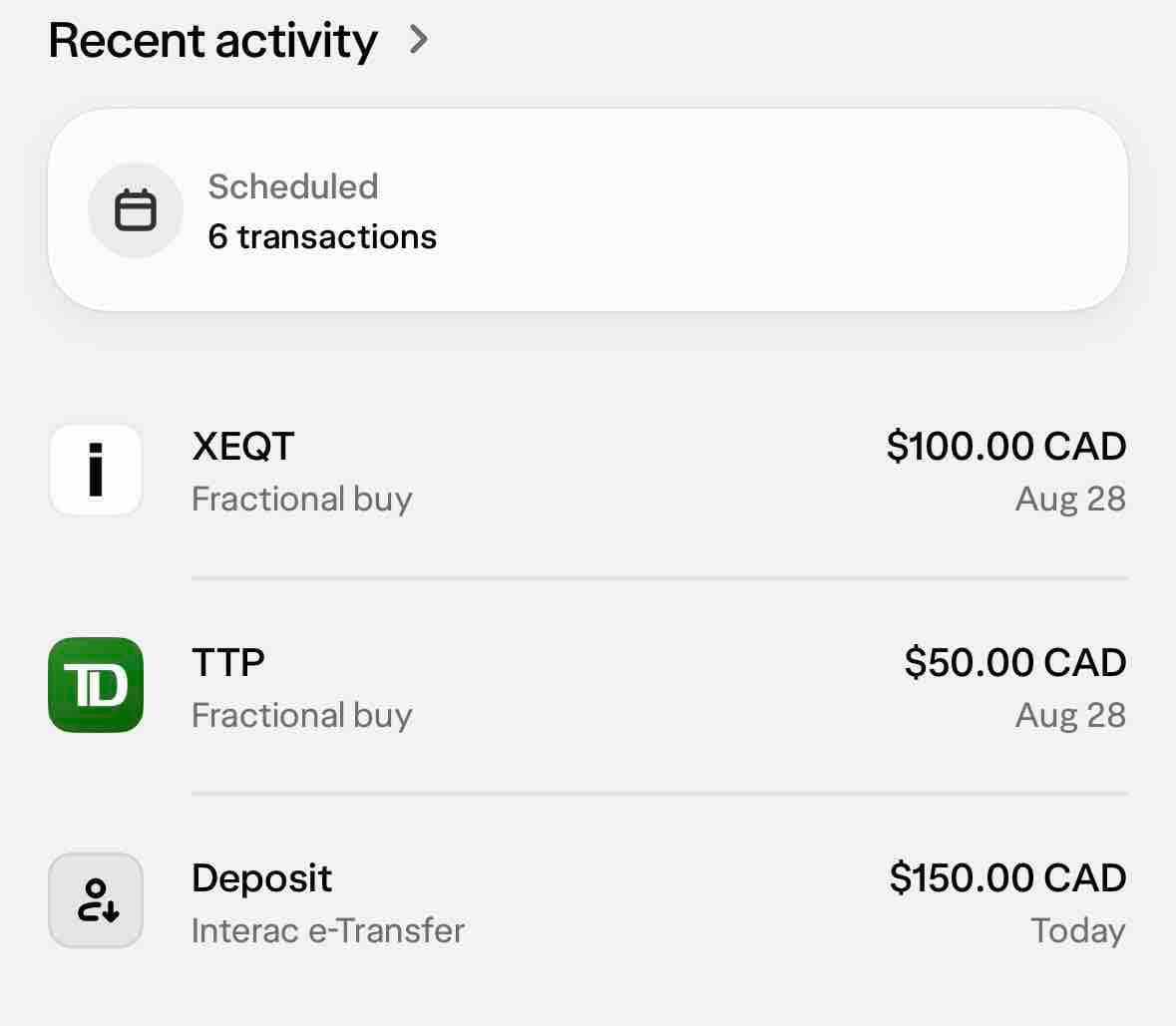
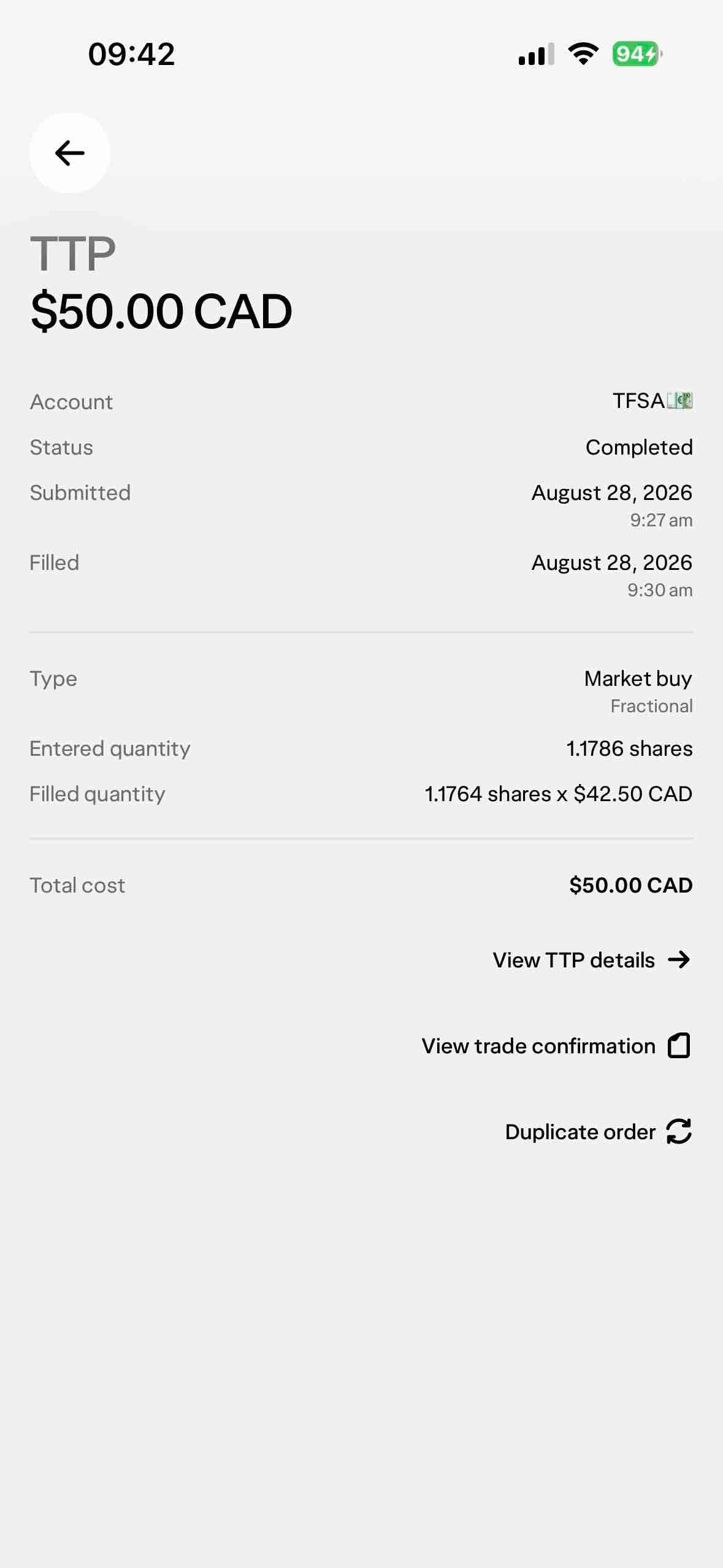
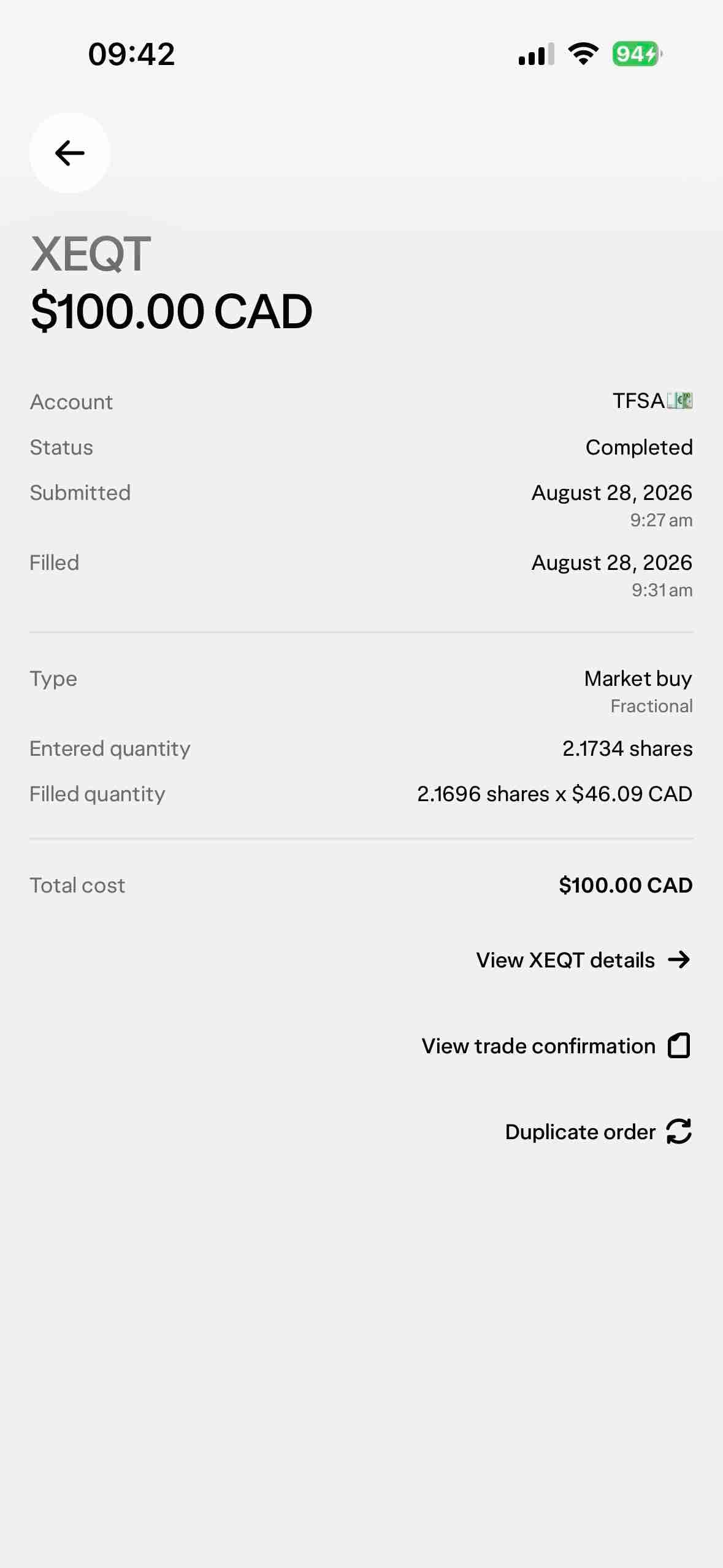
$SPCX$SPCX is now officially below it’s IPO price of $135. It reached $225.64 at it’s peak, meaning it would be down roughly 37% from ATH. On my TikTok I talked about how I think this would happen based on other IPO’s and I was spot on. FOMO is a portfolio killer, always do your research and build conviction in a position before putting your money in to it. I think SpaceX is a solid company, however, I can’t justify their market cap. What do you think? PS. If you own $XEQT$VEQT$ZNQ$QQC, you are a SpaceX investor by default :) read more
Paul Volcker The Man Who Had the Courage to Be Unpopular. He put America & Indeed Canada through a wold incredible pain. Most hated him. He chose recession over depression, it was mean and cruel and hard, he was hated….but… Does Warsh have the same kahones? “Sometimes leadership means choosing long-term prosperity over short-term popularity.” ⸻ At a Glance Who: Paul A. Volcker (1927–2019) Best Known For: Chairman of the U.S. Federal Reserve (1979–1987) Defining Achievement: Breaking the back of double-digit inflation, paving the way for decades of economic growth. Legacy: Widely regarded as one of the greatest central bankers in modern history. ⸻ A Giant in Every Sense Standing an imposing 6 feet 7 inches tall, often with a cigar in hand, Paul Volcker was impossible to miss. Yet it wasn’t his height that made him one of the most influential figures in financial history—it was his willingness to make decisions almost no one else was willing to make. History remembers very few central bankers. Investors remember Warren Buffett. Index investors remember John Bogle. Technology enthusiasts remember Steve Jobs. But when economists discuss courage, discipline, and independent leadership, one name consistently rises above the rest: Paul Volcker. His decisions changed the course of the American economy and affected every homeowner, investor, worker, and business owner in the United States. ⸻ America Was Losing Control When Volcker became Chairman of the Federal Reserve in August 1979, America faced an economic crisis unlike anything seen since the Great Depression. Inflation had exceeded 13%. Gasoline prices soared. Mortgage rates climbed relentlessly. Food prices rose every month. Families watched their purchasing power disappear. Businesses raised prices because they expected costs to continue rising. Workers demanded larger wages simply to keep pace. Inflation had become a vicious cycle. Volcker believed that unless someone acted decisively, inflation would permanently damage the American economy. ⸻ “Inflation is the cruelest tax because it quietly steals purchasing power from everyone.” ⸻ The Volcker Shock Most politicians wanted lower interest rates. Volcker did exactly the opposite. He instructed the Federal Reserve to raise interest rates aggressively. Eventually, the federal funds rate approached 20%. Mortgage rates exceeded 18%. Borrowing became painfully expensive. Almost overnight, the economy slowed. Factories reduced production. Businesses postponed expansion. Construction projects stopped. Auto sales collapsed. Farmers struggled to repay loans. Unemployment eventually climbed above 10%. America entered back-to-back recessions. Many believed Volcker had gone too far. ⸻ Timeline 1979 * Paul Volcker becomes Chairman of the Federal Reserve. 1980 * Interest rates surge. * First recession begins. 1981–1982 * Rates approach 20%. * Unemployment rises above 10%. * Inflation begins falling rapidly. 1982 * The economy bottoms. * A historic bull market begins. 1987 * Volcker leaves the Federal Reserve after helping restore price stability. ⸻ A Nation Turns Against Him As the recession deepened, public frustration became outright anger. That anger focused on one man. Paul Volcker. The protests became some of the largest ever directed at a Federal Reserve Chair. Farmers drove hundreds of tractors into Washington, D.C., surrounding the Federal Reserve building. Home builders mailed him two-by-fours and bricks, symbols of an industry that had nearly ground to a halt. Auto dealers mailed coffins containing the keys to unsold vehicles. Thousands of Americans wrote emotional letters describing businesses that had failed, farms they feared losing, and homes they could no longer afford. Politicians from both parties publicly condemned him. Editorials criticized him. Congress pressured him. Many Americans blamed him personally for the recession. For a time, Paul Volcker became one of the most unpopular men in America. ⸻ “The easiest decision would have been to lower interest rates. Volcker believed the right decision was to stay the course.” ⸻ Standing Firm Most leaders would have backed down. Volcker refused. He believed inflation was a far greater danger than a temporary recession. Allowing inflation to continue would slowly destroy savings, wages, investment, and confidence in the U.S. dollar. He accepted years of criticism because he believed temporary pain was the price of long-term prosperity. History would eventually vindicate him. ⸻ The Results Slowly but steadily, inflation collapsed. Confidence returned. Interest rates declined. Businesses began investing again. Consumers regained confidence. The economy recovered. What followed was one of the greatest economic expansions and stock market bull markets in American history. Many of today’s corporate giants—including Microsoft, Apple, Home Depot, and Walmart—expanded rapidly during the stable economic environment that followed. No single person created that prosperity. But few individuals did more to make it possible than Paul Volcker. ⸻ The Volcker Rule Following the 2008 Global Financial Crisis, Volcker once again influenced financial policy. He argued banks should focus on serving customers—not making speculative bets with federally insured deposits. His ideas became the Volcker Rule, a key part of post-crisis banking reform designed to reduce excessive risk-taking and strengthen the financial system. ⸻ Could Volcker Do It Again Today? More than forty years later, economists still debate one question. Would Volcker’s policies work today? The answer is yes—but at an even greater cost. The economic principles have not changed. Higher interest rates still reduce borrowing. Reduced borrowing slows spending. Lower spending cools inflation. What has changed is the amount of debt. Today’s governments, households, and corporations owe dramatically more money than they did in 1980. Interest rates approaching 20% today would likely produce: * A severe recession. * Significant declines in housing prices. * Increased corporate bankruptcies. * Much higher government borrowing costs. * Sharp stock market declines before recovery. That is why modern central banks generally try to act earlier, raising interest rates before inflation becomes deeply entrenched. Yet Volcker’s lesson remains timeless. Delaying difficult decisions usually makes the eventual solution even more painful. ⸻ Lessons Every Investor Can Learn Leadership Requires Courage The right decision is not always the popular one. Short-Term Pain Creates Long-Term Opportunity The greatest bull markets are often born from periods of maximum pessimism. Inflation Is an Invisible Tax Inflation quietly destroys purchasing power every day. Owning productive businesses has historically been one of the best ways to protect wealth. Discipline Beats Emotion Volcker ignored enormous pressure because he focused on long-term outcomes rather than short-term approval. Successful investors must often do exactly the same. ⸻ Why Paul Volcker Still Matters Paul Volcker never sought celebrity. He never measured success by opinion polls. He measured success by whether he fulfilled his duty. When confronted with one of the greatest economic challenges of the twentieth century, he chose conviction over comfort, principle over popularity, and long-term prosperity over short-term approval. History rewarded that courage. Today he is remembered not simply as the man who defeated inflation, but as one of the greatest central bankers in history. His story is ultimately about more than economics. It is about character. It is about discipline. It is about having the courage to endure temporary hardship in pursuit of a better future. For investors, that lesson is as valuable today as it was in 1980. ⸻ Final Thought “Markets recover. Economies heal. Inflation can be defeated. But only when leaders—and investors—have the courage to think beyond today’s discomfort and focus on tomorrow’s prosperity.” read more
TLDR: great results. In my eyes, we’re finally starting to see real profit and revenue generation as a direct result of AI CapEx. Which has been a huge drag on sentiment for Big Tech in 2026. One of the more interesting things from this quarter was seeing Google finally reach negative FCF, something that’s been projected for a while now, and something I wrote a post about not too long ago. But it means Google continues to see real returns from its investments, which we saw this quarter with cloud reaching over 80% growth and overall revenue reaching 24% growth. An unprecedented top-line growth rate for a $400 billion a year revenue business. As for earnings and EPS, I’d rather completely ignore that given the massive distortion from Google’s SpaceX and Anthropic stakes. Plus, inherently Google is already a GAAP profitable business, and earnings doesn’t tell you anything except that in this case. So it’s worth not diving into that too hard. Search revenue specifically also grew 17% YoY, which by itself is a hilarious statistic and means Search is now up ~$75b on a numbers basis, or +44% since ChatGPT destroyed the company back in 2023. Also, just this revenue addition alone, is roughly 3x more than the revenue OpenAI has generated in its entire history, combined. Google also showed around $240 billion worth of cash and equivalents sitting on its balance sheet. … though aside from this stat being a great headline for a Yahoo Finance article, it means nothing for me as an investor since most will be spent on continued CapEx, etc.  Overall, it’s a really interesting time for these companies. The takeaway here should be that Google shared great results, and that investments are leading to real dollars and profit. However, that simply means CapEx spend is only going to accelerate. (Which Google announced again that they are doing, hence why shares are down.) In the near term this means even more negative cash flow, likely more debt, etc., until demand bottoms out. Interestingly enough too, you may remember a couple weeks ago $META decided it was partnering with $AVGO (like Google and $AMZN and $MSFT have already done) to create a more cost sufficient in-house chip to replace and/or substitute $NVDA. And on this exact issue (which is why I brought it up), Google said this quarter that most of its cloud revenue is now being “primarily” generated off of their Nvidia in-house alternative… TPU chips. One of the core strengths of the Google thesis in general has always been that it was one of the first and only massive vertically integrated AI companies ever. And that holds today as well, but now other companies of similar scale are chasing that ordeal. Most notably Meta. But I’d say Amazon is the more underrated attempter at the moment. I think the real loser long-term is going to be Nvidia. Not overall (they’ll be around for a while), but in very core markets like with Big Tech, which at one point I believe took up about 20% of Nvidia’s total revenue. But I don’t keep up with him though as much, so I don’t know if that holds today. This is more an uneducated guess. Regardless though, YouTube, Gemini, now Gemini + iPhone, Google Cloud becoming the fastest growing and one of the largest Cloud platforms in less than a few years, Search continuing to grow thanks to AI integration and adaption… It’s hard not to be bullish here. Though I don’t want to be all pump and dumb, because there seems to be no end with the spending. And like I’ve said before, this is something to watch. The strategy at the moment for Google (and I’d be happy to guess most of Big Tech as well once we see their earnings) is to not stop spending (which would be a risk), but to become more efficient with its spending as it grows. Because for Google, the money being invested is already showing relative return, but the cost of investment is only going to rise since more returns gives management more incentive to spend. It’s a bit ironic, but that’s the cycle we’re in. Therefore the company (and most Big Tech companies) are betting on becoming more and more vertically integrated overtime to save costs, so they can make a bigger margin between the returns these investments are giving, and how much the investments are costing. (Broadcom, by the way, is one of only 2 companies in the world that these Big Tech companies are partnering with, for these in-house custom Nvidia-alternate chips. Them, and $MRVL. So it may be worth monitoring these two earnings as they come out as well.) Thanks for reading. Happy investing, folks. Earnings release: https://s206.q4cdn.com/479360582/files/doc_financials/2026/q2/2026q2-alphabet-earnings-release.pdf Cc: @bradleytalksmoney, @solofireread more
Many investors in Canada build their portfolios around popular ETFs like $VFV, $XEQT And there is nothing wrong with that. But one thing is worth asking: How much of your portfolio depends on Canada and the U.S. continuing to lead? The global market is bigger than North America. 🇯🇵 Japan — home to innovative companies and a changing corporate landscape. 🇹🇼 Taiwan — a critical player in the global semiconductor supply chain. 🇰🇷 South Korea — a leader in technology and manufacturing. 🌍 Europe & emerging markets — millions of consumers and businesses creating growth opportunities. Diversification is not about predicting the next winner. It is about owning pieces of the global economy and reducing the risk of being concentrated in one region. The best-performing market of the next decade may not be the same one that led the last decade. A truly global portfolio doesn’t just own yesterday’s winners — it stays invested in tomorrow’s possibilities. 🌱 Do you have exposure outside North America? read more
If 🐻 can get a daily close below 63k, then watch for the next leg down into the October low. Need a weekly close above the Greenline to consider the 🐻 market from October 2025 is completed.
To achieve a minimum 7% CAGR while keeping historical maximum drawdown strictly under 20% through both the 2020 COVID crash and the 2022/2023 bear market, you cannot rely solely on equities. During March 2020, both XEQT and XDIV suffered drawdowns exceeding 25%. The optimal all-weather asset allocation to safely clear performance floor while mitigating downside risk is a Balanced Multi-Asset Hybrid portfolio. ------------------------------ ## The Optimal Asset Allocation Mix * * 35% XEQT.TO (iShares Core Equity Portfolio) * Role: Primary long-term global growth engine (U.S., International, and Emerging Markets). * 25% XDIV.TO (iShares Core MSCI Canadian Quality Dividend) * Role: Domestic value anchor providing stable, low-volatility monthly dividend cash flow. * 25% CBIL.TO (Global X 0-3 Month T-Bill ETF) * Role: Risk-free cash cushion providing zero-volatility interest yields to absorb stock market crashes. * 15% ZGLD.TO (BMO Gold Bullion ETF) * Role: Systemic crisis hedge and inflation insurance. Gold historically runs counter to equity bear markets. * ------------------------------ ## Backtested Performance Analysis (2020–2026) | Metric | Portfolio Target | Combined Backtest Result | Analysis | |---|---|---|---| | CAGR | Min 7.00% | ~7.85% | Passed. Handily exceeds the 7% threshold due to strong global equity compounding and surging gold prices. | | Max Drawdown | Max -20.00% | ~-14.80% | Passed. The 40% combined cushion of T-Bills and Gold completely insulated the portfolio during the 2020 crash. | ------------------------------ ## How This Allocation Survived the Historical Milestones## 1. The 2020 COVID-19 Crash (March 2020) * * The Threat: Pure equity allocations (100% XEQT or XDIV) collapsed by roughly 25% to 28% in a matter of weeks. * The Savior: Your 60% equity exposure dropped the portfolio by about 16%. However, CBIL lost 0%, and ZGLD acted as a powerful shock absorber, quickly recovering to hit all-time highs later that year. This limited the overall portfolio drawdown to a highly manageable -14.80%. * ## 2. The 2022–2023 Inflationary Bear Market * * The Threat: Rising interest rates severely penalized broad global indexes, causing XEQT to slide into a prolonged double-digit correction. Traditional bond portfolios also failed to act as a hedge. [9] * The Savior: XDIV heavily protected the equity side because Canadian financial and energy dividends surged during the inflationary cycle. Simultaneously, CBIL's yield automatically climbed from 0.5% to over 4.5% as central banks hiked rates, providing an increasing, risk-free stream of interest. read more
I was thinking about the active vs passive investing debate. Some people spend years trying to beat the market. Others just buy an index fund and leave it alone. And honestly, the data is pretty humbling. Most professional fund managers, with teams of analysts and millions of dollars in research, still struggle to beat a simple index fund over the long term. So why do I still buy individual stocks? Because I don’t think it has to be one or the other. I like having a core portfolio that gives me broad market exposure. Something like $XEQT, $VOOor$QQQM. Then I can use a smaller part of my portfolio to invest in companies I genuinely believe can outperform. $NVDA $AMZN $MSFT $VISA $TSM The problem isn’t really active investing. The problem is how most people do it. They buy when everyone is excited. Sell when the market crashes. Chase whatever stock is trending. Then repeat the cycle. Buying a stock is easy. Holding it through a 30%, 50% or even 70% decline is where the real test begins. That’s why I think the best strategy is probably the one you can actually stick with. For me: 🌎 Core = own the market 🚀 Satellite = own a few businesses I strongly believe in Then keep investing and stop trying to predict every short-term move. Because the biggest advantage most investors have isn’t some secret stock tip. It’s time. And the ability to stay invested when everyone else is panicking. That’s boring. But boring is often what actually builds wealth. 📈 read more